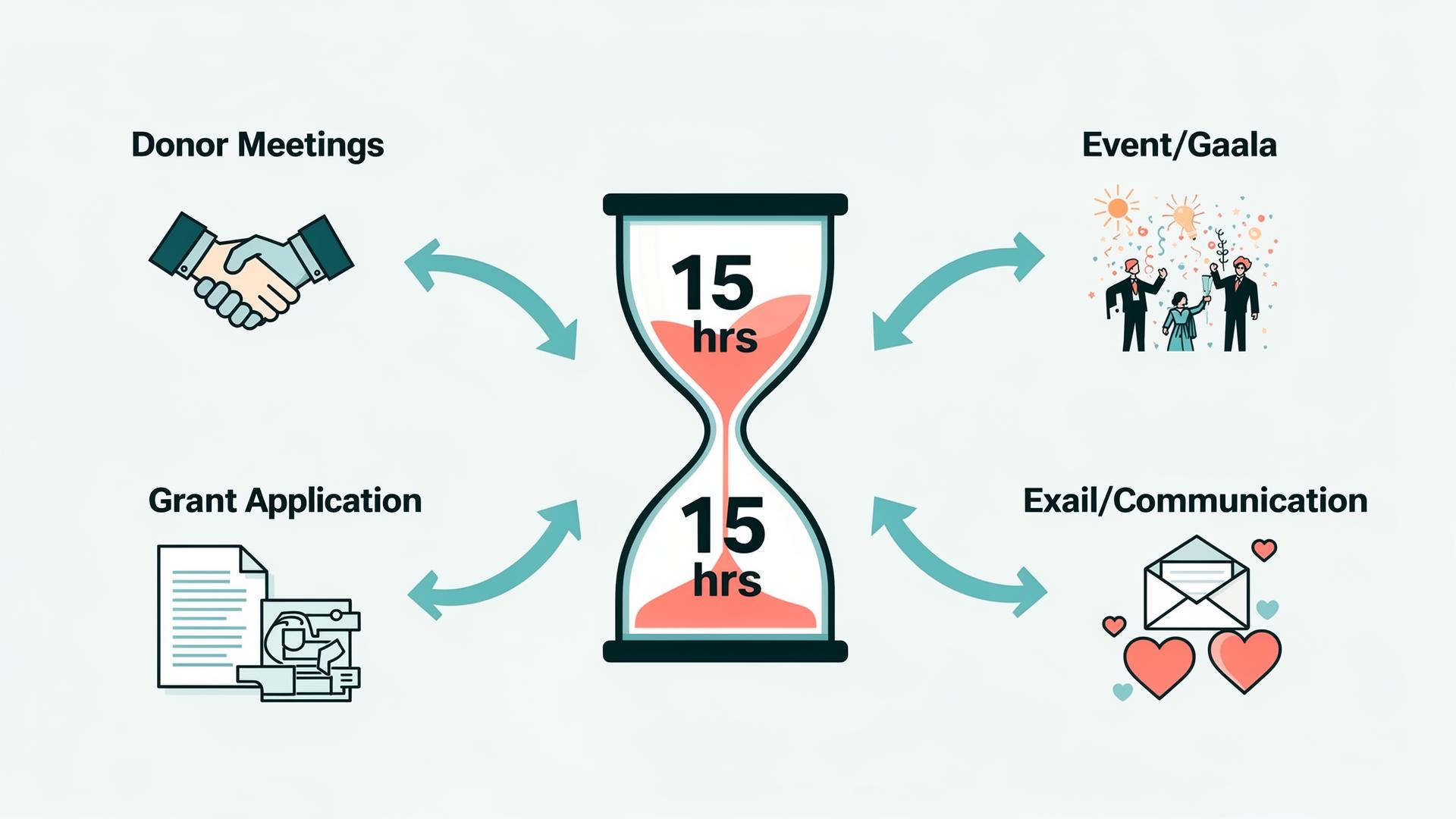
The ROI of 15 Hours: Where That Number Comes From, and How to Find Yours
On this page
- Where the 15 hours figure comes from
- What the sector actually measures
- Why saved time is not the same as gained time
- A two-week time audit you can finish
- Turning hours into a number your board will act on
- What to ask a vendor about time savings
- What to do with the answer
- Where Gratefully fits
- Frequently asked questions
Where the 15 hours figure comes from
It comes from nowhere, and we should start by saying that this page used to be one of the places repeating it.
Search for fundraising software and you will be told how many hours it gives back. Fifteen a week. Forty a month. Eighty a season. The figures are specific enough to sound measured and they are almost never sourced. We checked two at the publisher rather than trusting a summary of them. Submittable's homepage carries "80+ hours saved per season" as a product statistic, sitting beside "4 weeks to launch," with no source or methodology attached to either. Giveffect's homepage says a team can "save 40 hours monthly, not doing manual work," with no source either.
Neither company is doing anything unusual. This is the convention of the category. But a number with no methodology behind it is not a measurement, and it is worth being precise about what that means for a buyer: you cannot use an unsourced hours-saved claim to compare two tools, and you cannot use it to predict what will happen at your organization. It tells you the vendor believes its product saves time. You already assumed that.
The deeper problem is that hours-saved claims are unfalsifiable in the one direction that matters. If you buy the tool and gain four hours instead of fifteen, there is no baseline to appeal to, because nobody measured your before.
What the sector actually measures
This is where a page like this normally produces a better statistic. We could not find one, and the absence is worth documenting because it is not for want of looking.
We checked the three largest recent surveys of nonprofit capacity and technology we could find. None of them asks how the week is spent.
The deepest one on capacity is UnderDeveloped: A National Study of Challenges Facing Nonprofit Fundraising, by Jeanne Bell and Marla Cornelius, published by CompassPoint and the Evelyn and Walter Haas, Jr. Fund in 2013. It surveyed more than 2,700 executive directors and development directors. It is thorough, and it does not measure time use at all. What it does establish:
- 21% of organizations had no fundraising database. Among organizations with budgets under $1 million, 32% had none.
- 23% had no fundraising plan, rising to 31% under $1 million.
- Setting aside a subset the study calls high performers, meaning organizations drawing a quarter or more of their budget from individual donors and rating their own fundraising very effective, only 9% strongly agreed their organization had sufficient capacity to carry out its fund development activities.
That last figure is the closest the sector gets to the claim this page used to make, and it is worth reading precisely. It counts respondents who *strongly* agreed. The rest is not a group who said they lacked capacity, it is everyone who did not answer at the top of the scale, so the honest reading is that confident capacity was rare rather than that 91% were short of it. How many hours anyone was losing, and to what, the study does not say. The report is also thirteen years old, which matters for any claim about tooling.
The largest recent one is Salesforce's Nonprofit Trends Report, 7th Edition, published in 2025 from a global quantitative survey of 1,229 nonprofits. Fundraising returned as the sector's number one challenge, ahead of staffing, for the first time in four years. Only 26% of the organizations surveyed are not using AI at all. It does not measure time on administrative work either.
The most recent is Virtuous's 2026 Nonprofit AI Adoption Report, from 346 organizations surveyed in December 2025. It finds that 81% use AI on an ad hoc basis without documented workflows and 47% have no AI governance policy. It does not measure time either, and those two figures suggest why almost nobody does. An organization running AI without a documented workflow has no before to compare an after against.
Outside the nonprofit sector, the general-workplace numbers people reach for are weaker than their circulation suggests. Martin White, an information scientist who has written several books on enterprise search, traced the widely quoted claim that workers spend two and a half hours a day searching for information back to a 2001 IDC briefing paper, where it was explicitly an estimate rather than a measurement. His conclusion is the useful part, and it applies directly here: "Time spent searching is a meaningless metric without being attributed to a group of users undertaking similar tasks within a similar context and using a replicable methodology."
Your development team is a group of users undertaking similar tasks in a similar context. Nobody has measured them. You can.
Why saved time is not the same as gained time
Before measuring anything, there is a logical gap in the standard pitch worth closing, because it survives even when the hours are real.
The argument runs: the tool saves fifteen hours, those hours go into donor meetings, more meetings produce more revenue. Every step after the first is an assumption.
Saved time does not arrive in useful blocks. Twelve minutes recovered here and eight there does not become a cultivation visit. It becomes a slightly less compressed day. Time only converts into donor work when it arrives in pieces large enough to hold a meeting, a call or a proposal, and whether it does depends on where the time was going, not how much of it there was.
Saved time is claimed by whatever was already waiting. In an organization where confident capacity is rare, recovered hours flow to the most overdue thing, and that is rarely donor cultivation. It is usually the report that is late.
Some administrative work is the job. Recording what a donor said is not overhead. It is the thing that makes the next conversation possible, and it is what an organization loses when a fundraiser leaves. A tool that removes the recording of donor knowledge is not saving time, it is deferring a cost.
So the question worth answering is not "how many hours could we save." It is which hours, from whom, and what would actually fill them. That question has an answer you can get in two weeks.
Muddsar Jamil, founder, Gratefully. Every team I speak to wants to know how many hours the software will save them, and I say this as the person selling the software: it is the wrong first question. Until you know which hours you are losing and to what, an hour given back just moves the problem somewhere else. The organizations that get the most out of any tool are the ones who could already tell you where their week goes.
A two-week time audit you can finish
Most time audits fail because they ask for too much precision. This one is built to be finished, not to be perfect. Two weeks, whole team, five categories.
- Pick two ordinary weeks. Not the week before a gala, not year end, not the week someone is on leave. If your weeks are never ordinary, pick two and note what was unusual about them.
- Use five categories and no more. *Donor-facing* (meetings, calls, personal emails, visits). *Preparing donor-facing work* (research, briefing, drafting an ask). *Recording and admin* (data entry, gift processing, updating records, chasing acknowledgments). *Reporting* (board packets, grant reports, dashboards, funder compliance). *Everything else* (meetings, email, travel, management). Any more granularity and people stop logging.
- Log in thirty-minute blocks, at three fixed points a day. Mid-morning, after lunch, end of day. Reconstructing three hours is accurate enough and it is a habit people can hold for ten days. Real-time logging is more accurate and nobody sustains it.
- Log the whole team, including the executive director. In organizations with two or three development staff, a large share of donor work sits with the ED, and a tool that helps the team but not them will not change the number that matters.
- Record interruptions separately, as a tick. Not the time, just a mark whenever someone switches tasks because of a request. This is the cheapest signal in the whole exercise and it tells you whether the problem is volume of work or fragmentation of it. They need different solutions and only one of them is software.
- Add up by category, then look at the shape. You want two numbers per person: hours in each category, and the size of the largest uninterrupted block of donor-facing time in a typical week. The second number is the one people forget and it is the one that predicts whether recovered time can ever become a cultivation visit.
Ten working days. About four minutes a day per person. At the end you have something no vendor can give you, which is your own baseline.
Turning hours into a number your board will act on
Hours do not travel well to a board. Money does. The conversion is straightforward and the only input you need is real salary data you already hold.
Fully loaded hourly cost is annual salary plus benefits and employer taxes, divided by working hours in a year. If benefits and taxes add roughly 25% to 30% on top of salary, which is typical but which you should check against your own payroll rather than assume, and a full-time year is about 2,080 hours, then someone on a $70,000 salary costs roughly $42 to $44 an hour to employ.
Worked through with illustrative figures, not benchmarks:
| Step | Example | Your number |
|---|---|---|
| Hours per week in "recording and admin" across the team | 22 | |
| Share you believe a tool could remove | 40% | |
| Hours recovered per week | 8.8 | |
| Weeks per year | 46, allowing for leave and holidays | |
| Hours recovered per year | 405 | |
| Fully loaded hourly cost | $43 | |
| Annual value of recovered time | $17,415 |
Three rules make this defensible rather than decorative.
Use the share you believe, not the share the vendor claims. If you cannot say why you chose 40%, choose a number you can defend and say so in the footnote. A conservative figure you can explain beats an optimistic one you cannot.
Say plainly that this is cost avoided, not revenue gained. Recovered hours are not income. They become income only if they turn into donor work that produces gifts, which is exactly the assumption this page warns about. Present it as capacity released and let the board decide what it is worth.
Put the same hours into your cost per dollar raised. Staff time is usually the largest fundraising cost and the one most often excluded, which quietly flatters the result. Our fundraising metrics and benchmarks guide sets out how that calculation works and which fundraising metrics have a defensible sector benchmark behind them. Once you have measured staff time properly, it belongs in that number.
What to ask a vendor about time savings
With a baseline in hand, four questions do most of the work. They are not adversarial. A vendor with a real answer will be glad to be asked.
- Where does that hours figure come from? The useful answer names how it was measured, across how many organizations, over what period. "One customer told us" is an honest answer and tells you how much weight to put on it. No answer tells you more.
- Which of my five categories does it reduce? Point at your own audit. A tool that removes reporting time is a different purchase from one that removes gift-processing time, and your numbers say which you need.
- What new work does it create? Every system has a maintenance cost: reviewing what it drafted, correcting what it mismatched, maintaining the connection to your CRM. Net hours are the only hours that count, and a vendor who says the cost is zero has not run the tool for long.
- What happens to the time in month three? Setup savings and steady-state savings are different numbers. Ask which one the claim describes.
What to do with the answer
The audit resolves into one of three findings, and only one of them is a software problem.
Recording and admin is a large share and it is concentrated. One or two people, doing a defined task, on a predictable rhythm. This is the case software addresses well, and you now have the baseline to hold a vendor to.
The hours are not large, but they are fragmented. Total admin time is modest and nobody has an uninterrupted block longer than forty minutes. The interruption ticks will show this. Software rarely fixes fragmentation and sometimes adds to it. The fix is scheduling and boundaries, and it is free.
The hours are going to reporting, not to donors. This is common and it is usually a funder compliance load rather than an efficiency problem. Worth knowing before buying a tool aimed at something else.
Whichever it is, you will have spent two weeks and learned the actual shape of your team's work. That is worth more than the fifteen hours this page used to promise, because it is true.
Where Gratefully fits
We are not going to tell you how many hours Gratefully saves, because we have not measured it in a way that would let us tell you honestly, and a number we cannot defend is worth less than no number.
What we can describe is the mechanism. Gratefully connects to the systems you already use, your CRM, plus the documents and files you upload, and turns what is in them into something you can ask questions of in plain language, with every answer traceable to the record it came from. The work it targets sits in two of your five categories: recording and admin, which is writing notes back and keeping records current, and preparing donor-facing work, which is finding what was said before a meeting. Whether those categories are large at your organization is exactly what the two weeks will tell you. If it is small, we are not your priority, and you will have found that out for the price of ten days of ticking boxes.
Last updated August 21, 2026.
Frequently asked questions
How many hours a week do nonprofit fundraisers spend on admin?
We could not find a published study that measures it. The three largest recent surveys of nonprofit capacity and technology all skip the question: UnderDeveloped by CompassPoint and the Haas, Jr. Fund in 2013 surveyed more than 2,700 executive and development directors without measuring time use, Salesforce's 2025 Nonprofit Trends Report covers 1,229 nonprofits without measuring it, and Virtuous's 2026 AI Adoption Report covers 346 organizations without measuring it. Any specific figure you see is an estimate presented as a finding. The only reliable number is one you measure at your own organization.
How do you run a time audit for a fundraising team?
Pick two ordinary weeks, use five categories, and log in thirty-minute blocks at three fixed points a day. The categories are donor-facing work, preparing donor-facing work, recording and admin, reporting, and everything else. Include the executive director. Record interruptions as a tick rather than a duration. Ten working days at about four minutes a day per person gives you a baseline no vendor can supply.
How do you calculate the value of time saved by fundraising software?
Multiply the hours recovered per week by working weeks in the year, then by fully loaded hourly cost, which is salary plus benefits and employer taxes divided by about 2,080 hours. Present the result as cost avoided rather than revenue gained, because recovered hours only become income if they turn into donor work that produces gifts.
Are vendor claims about hours saved reliable?
They are usually estimates without methodology. Submittable's homepage carries "80+ hours saved per season" as a product statistic, and Giveffect's says teams "save 40 hours monthly," neither with a source given. Neither is dishonest, but a figure with no methodology cannot be used to compare two tools or to predict your own result. Ask how it was measured, across how many organizations, and over what period.
Does saving administrative time actually increase fundraising revenue?
Not automatically. Recovered time arrives in fragments that rarely combine into a donor meeting, and it tends to be claimed by whatever work was already overdue. It converts into revenue only when it arrives in blocks large enough to hold a call, a visit or a proposal. Measuring the largest uninterrupted block of donor-facing time in a typical week tells you more than the total.
Author
Muddsar Jamil, Founder, Gratefully
Muddsar Jamil is the founder of Gratefully and a 20-year Silicon Valley engineer (Adobe, Workday, SugarCRM) who spent nearly as long volunteering with Bay Area nonprofits. He built Gratefully so donor relationships survive spreadsheets, staff turnover, and guesswork. Connect on LinkedIn.
Want more insights like this? Browse all articles or get in touch with our team.