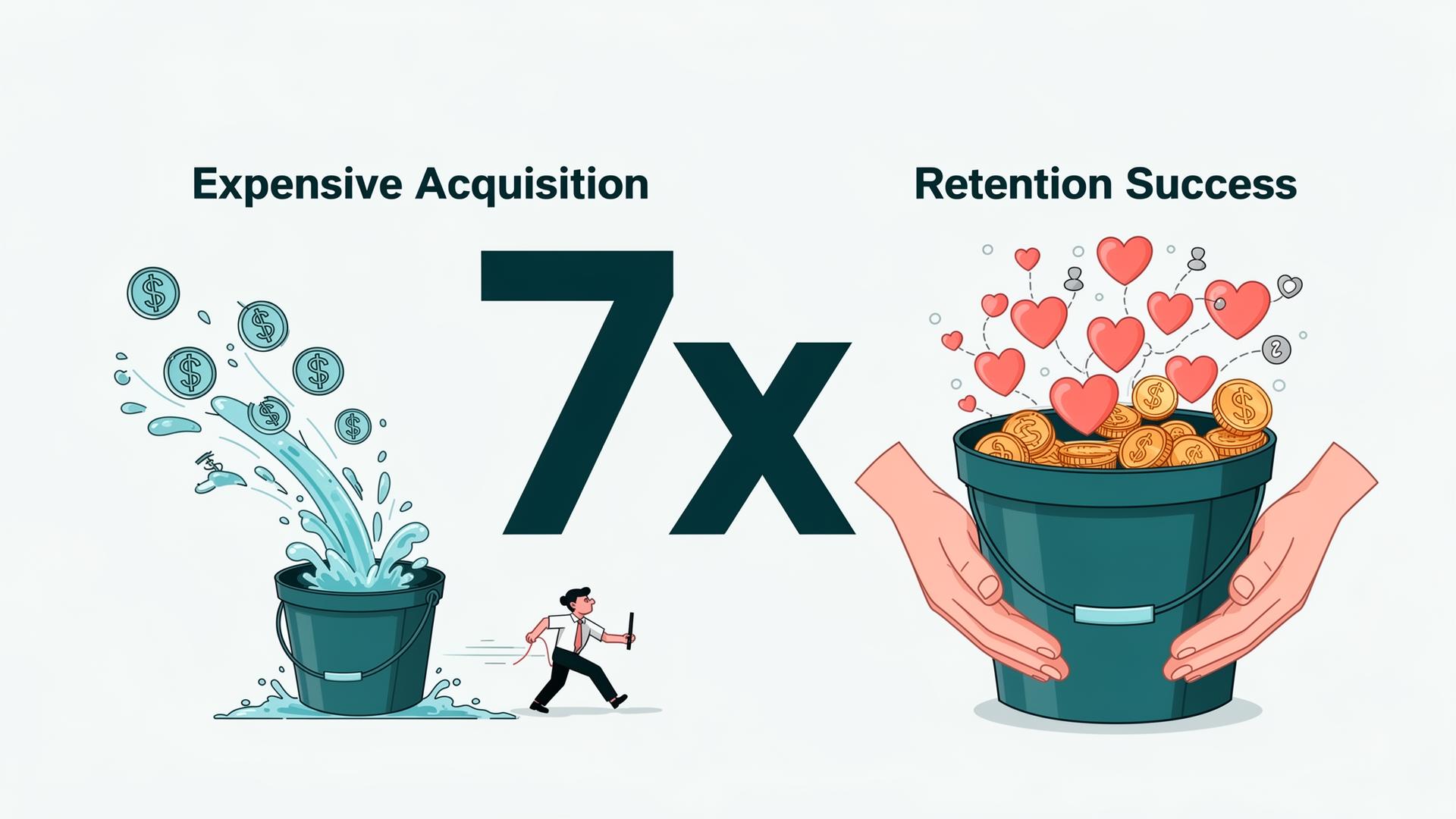
The 7x Rule of Donor Acquisition: What Replacing a Donor Really Costs in 2026
Fundraisers have cited the same range for years: acquiring a new donor costs somewhere between five and ten times what it costs to keep an existing one, with 7x the commonly used midpoint. We went looking for the cost research underneath that range. It holds up, and the arithmetic is worse than the shorthand suggests, because only 18.9% of first-time donors give again.
On this page
- Where the 7x rule comes from
- The three numbers that support the range
- What the research really shows
- How to calculate your real donor acquisition cost
- The break-even math nobody shows you
- Three ways to grow, ranked by cost
- What a 10-point retention improvement is worth
- Monthly giving: the retention outlier
- What to do this quarter
- How Gratefully helps
- Frequently asked questions
Where the 7x rule comes from
The rule is usually stated as a range rather than a single figure. It costs five to ten times more to acquire a new donor than to retain an existing one, and 7x is the midpoint most people reach for. The range has two well-established roots.
The commercial root. Frederick Reichheld's work at Bain, published in Harvard Business Review in 1990 and revisited in 2000, established the economics of customer retention. His central published finding is that a 5% increase in customer retention increases profits by 25% to 95%. A 2014 HBR article by Amy Gallo summarised the acquisition-versus-retention cost gap as "5 to 25 times more," which is where the wide upper bound in circulation comes from.
The nonprofit root. Fundraising researcher Adrian Sargeant, writing in Nonprofit Quarterly in 2013, put it directly: "It typically costs around five times as much to solicit a new customer as it does to do business with an existing one." That is the floor of the range.
The useful question is not which single number is correct. It is whether the magnitude survives contact with actual nonprofit cost data. It does, and three independent lines of evidence land inside the range.
The three numbers that support the range
| Line of evidence | What it measures | Implied multiple | Source |
|---|---|---|---|
| Cost to raise a dollar | Direct mail acquisition at $1.00 to $1.25 per dollar raised, against direct mail renewal at $0.20 | 5x to 6.25x | Greenfield, Fund-Raising: Evaluating and Managing the Fund Development Process (Wiley) |
| Cost to solicit | Soliciting a new supporter against doing business with an existing one | ~5x | Sargeant, Nonprofit Quarterly, 2013 |
| Retention-adjusted acquisition cost | Naive cost per new donor divided by the 18.9% who give again, giving the true cost per donor who stays | ~5.3x | Calculated from Fundraising Effectiveness Project, Q4 2025 |
Three different methods, three results clustering between five and six times.
Here is the part most articles skip, and we would rather be straight with you about it. The cost evidence that can be traced to a named source supports the lower half of the five-to-ten range. The figures at the upper end circulate widely across sector publications, but they are difficult to tie back to underlying cost data. So 7x is a defensible planning assumption, sitting just above what the documented costs show. Anything approaching 10x should be treated as rhetorical rather than measured.
The reason the real multiple can still run higher than the cost tables suggest is retention. Those cost ratios compare campaign against campaign. They do not account for the fact that only 18.9% of the donors you acquire will give again, which is the subject of the rest of this article.
Greenfield's full benchmark table is worth keeping, because it prices every lane you might use:
| Fundraising activity | Average cost to raise one dollar |
|---|---|
| Capital campaign and major gifts | $0.05 to $0.10 |
| Corporate and foundation grant writing | $0.20 |
| Direct mail renewal (existing donors) | $0.20 |
| Planned giving | $0.25 |
| Benefit and special events | $0.50 of gross proceeds |
| Direct mail acquisition (new donors) | $1.00 to $1.25 |
| National average, all fundraising | $0.20 |
Read top to bottom, that table is the entire argument of this article in one column. Acquiring a stranger by mail is the single most expensive thing on the list, by a factor of five against renewing someone you already have, and by a factor of ten or more against a major gift conversation.
That last row is the one worth sitting with, because it is the only one you can calculate for your own organisation, and it is the version of the rule that actually changes decisions.
What the research really shows
Three findings, each from a primary source, each sharper than the shorthand:
Acquisition usually costs more than the first gift brings in. Sargeant's nonprofit-specific finding (Nonprofit Quarterly, 2013): "it typically costs nonprofits two to three times more to recruit a donor than a donor will give by way of a first donation." James Greenfield's cost-per-dollar benchmarks (Fund-Raising: Evaluating and Managing the Fund Development Process, Wiley) put direct mail donor acquisition at $1.00 to $1.25 spent per $1.00 raised, against roughly $0.20 per dollar for fundraising overall. Acquisition is not profitable in year one. It is an investment that only pays back if the donor stays.
Most new donors do not stay. The Fundraising Effectiveness Project (AFP and GivingTuesday), which tracks giving across thousands of US nonprofits, reports for full-year 2025:
| Retention measure | Rate | Source |
|---|---|---|
| First-time donor retention | 18.9% | Fundraising Effectiveness Project, Q4 2025 |
| Repeat donor retention | 59.3% | Fundraising Effectiveness Project, Q4 2025 |
| Overall donor retention | 43.3% | Fundraising Effectiveness Project, Q4 2025 |
| Lapsed donor recapture | 3.0% | Fundraising Effectiveness Project, Q4 2025 |
| Monthly sustainers active at 12 months | 71% | M+R Benchmarks, 2026 |
Read the first row again. Roughly 4 in 5 first-time donors do not give again the following year. Which means the real cost of acquisition is not what you spent per new donor. It is what you spent per new donor who stayed.
The gap between first-time and repeat retention is the whole game. A donor who makes a second gift retains at 59.3%, more than three times the first-timer rate. Getting gift two is the single highest-leverage conversion in fundraising. The 2026 Virtuous Nonprofit Benchmark Report (771 mid-sized US nonprofits) measured first-to-second gift conversion at 25.84% on average, with a typical 108.5 days between first and second gift. Top-quartile organizations convert 37.86% and cut the gap to 68 days.
How to calculate your real donor acquisition cost
Donor acquisition cost (DAC) is the total amount you spend to win a first gift from a new donor: campaign costs, media spend, list rental, events, plus the staff time behind them, divided by the number of new donors acquired.
Donor retention rate is the percentage of donors who gave in a prior period and gave again in the current one.
Effective acquisition cost per retained donor is your DAC divided by your first-year retention rate. It is the number almost nobody calculates, and it is the one that decides whether acquisition pays back.
Here is the calculation, step by step:
- Total your true acquisition spend. Everything aimed at first gifts for one period: ads, direct mail to cold lists, acquisition events, plus the loaded staff hours spent on them. Leave out stewardship and renewal costs; those belong to retention.
- Divide by new donors acquired. That is your naive DAC. If you spent $12,000 and won 200 new donors, your DAC is $60.
- Divide your DAC by your first-year retention rate. This is the step that changes the picture. At the sector-average 18.9% first-time retention, that $60 DAC becomes $60 / 0.189, roughly $317 per donor who actually stays.
- Compare against multi-year value, not the first gift. A retained donor's value compounds: repeat donors retain at 59.3%, upgrade more often, and are the pool from which major and planned gifts come. Judge the $317 against that, not against a $50 first gift.
- Re-run it quarterly. Retention rates move. The Fundraising Effectiveness Project publishes quarterly, so benchmark against the current numbers, not a stat from a 2022 blog post.
The break-even math nobody shows you
Work one cohort through. Your numbers will differ, the shape will not. This example spends $12,000 to acquire 200 new donors at a $50 average first gift, then applies sector-average retention.
| Stage | Donors still giving | Revenue that year | Running position |
|---|---|---|---|
| Year 1: acquisition, $12,000 spent | 200 | $10,000 | -$2,000 |
| Year 2: at 18.9% first-year retention, $60 average gift | 38 | $2,280 | +$280 |
| Year 3 onward: survivors retain at 59.3% and upgrade | ~23 and compounding | rising | profitable |
Read the first row. You are underwater in year one, exactly as Sargeant's two-to-three-times finding predicts. You break even somewhere in year two, and you do it on the backs of 38 people out of 200. Every one of those 38 is a retention outcome, not an acquisition outcome.
Now hold the acquisition spend constant and improve only what happens after the first gift. In the 2026 Virtuous benchmark, average organizations convert 25.84% of first-time donors to a second gift; top-quartile organizations convert 37.86%. That single difference adds nearly half again to the cohort's second-gift revenue and pulls break-even months earlier. Same acquisition spend. Same donors. The difference is entirely in stewardship after the first gift.
That is the real lesson inside the 7x rule, and it is the part the shorthand leaves out. Acquisition and retention are not competing strategies. Retention is what determines whether acquisition was worth doing at all, and it is also what sets the size of the multiple in the first place. Improve retention and you do not just save money on the retention side of the ledger, you shrink the acquisition multiple itself.
Three ways to grow, ranked by cost
Every "acquisition vs retention" article ends with "do both." That is true and useless. The practical version is a cost ranking with three lanes, not two:
| Lane | Cost to raise a dollar | How the audience behaves | Sector performance |
|---|---|---|---|
| 1. Retain the donors you have | ~$0.20 (fundraising overall) | Already know and trust you | 59.3% repeat retention |
| 2. Reactivate the donors you lost | A fraction of cold acquisition | Said yes before, history on file | 3.0% recaptured, mostly from neglect |
| 3. Acquire strangers | $1.00 to $1.25 | No relationship to build on | 18.9% first-year retention |
The full multiple only applies to lane three. Lanes one and two are where the cheap revenue lives.
- Retain the donors you have (cheapest). Fundraising overall runs around $0.20 per dollar raised (Greenfield), and current donors already know and trust you. Every retained donor also compounds: 59.3% repeat retention versus 18.9% for first-timers.
- Reactivate the donors you lost (middle). The sector recaptures only 3.0% of lapsed donors (FEP, 2025), not because win-backs do not work but because almost nobody runs them systematically. These are people who already said yes once; you hold their history, and a diagnosis-first win-back sequence costs a fraction of cold acquisition. Our lapsed-donor re-engagement guide covers the full playbook.
- Acquire strangers (most expensive). Necessary, because even good retention loses donors to attrition every year. But it runs at $1.00 to $1.25 per dollar in year one and should be sized against your retention rate, not run on autopilot.
Note where the cheap lanes live. Lanes one and two are both work you do inside the database you already own, against people who already said yes. Lane three is the only one where you pay the full multiple. Your next major gift is far more likely to come from lanes one and two than from a cold list.
What a 10-point retention improvement is worth
The most-cited finding in retention economics is Adrian Sargeant's (Nonprofit Management and Leadership, 2001): "A 10 percent improvement in attrition can yield up to a 200 percent increase in projected value, as with lower attrition significantly more donors upgrade their giving, give in multiple ways, recommend others, and, ultimately, perhaps, pledge a planned gift to the organization."
Three precision notes, because this quote is usually mangled:
- It is a 10-point improvement in attrition (donors lost), not a 10% bump in revenue.
- The gain is in projected database value, the modeled long-term value of your donor file, not next quarter's income.
- "Up to 200%" is the ceiling Sargeant modeled, not an average. Treat it as directional: retention gains compound through upgrades, second channels, referrals, and eventually bequests.
Even read conservatively, it says the same thing as the break-even math above: a point of retention is worth many points of acquisition.
Monthly giving: the retention outlier
One giving structure quietly beats every retention benchmark in this article: monthly giving. M+R's 2026 Benchmarks study reports 71% of monthly sustainers still active at 12 months, against 43.3% overall donor retention. (You will see "90% recurring retention" quoted elsewhere; that figure traces to vendor marketing, not published research, so we use M+R's.)
The implication for acquisition math: a new donor converted to monthly giving in their first 108 days jumps from an 18.9% retention pool to a 71% one. If you buy acquisition at all, buying it into a monthly program is the only version where year-one economics can actually work.
What to do this quarter
- Calculate your effective DAC. Steps above. If you cannot assemble the inputs from your systems in under an hour, that is a data problem worth fixing first.
- Instrument the second gift. Measure your first-to-second conversion rate and your median days between first and second gift. Sector average is 25.84% and 108.5 days; top quartile is 37.86% and 68 days (Virtuous, 2026). Whatever you measure, the window is a few months, not a year.
- Thank before you ask again. First-time donors who receive a prompt, specific acknowledgment, tied to what their gift actually did, convert to a second gift at meaningfully higher rates. Specificity beats speed alone: "your $50 funded five hot meals for the students in our spring program" outperforms a generic receipt. Our donor stewardship guide sets out the full cadence by donor tier, including who owns each one.
- Segment before you spend. Acquisition budgets get set before anyone has looked at who is already in the file. Our guide to RFM analysis covers a defensible way to rank your existing donors by recency, frequency and value first.
- Run a lapsed-donor lane. The 3.0% sector recapture rate is not a law of nature, it is a measure of neglect. Segment your lapsed file, diagnose why each cohort left, and run win-backs before you buy another cold list. Start with which donors are at risk of lapsing so next year's lapsed file is smaller.
- Put the savings math in front of your board. Boards approve acquisition budgets because acquisition is legible: spend money, count new names. Show them effective DAC per retained donor next to the cost of a retention program, and the conversation changes.
For the full strategy layer on top of this math, see our donor retention strategies playbook.
How Gratefully helps
Everything above is arithmetic any spreadsheet can do once. The hard part is doing it continuously, for every donor, while running a development office. That is the job Gratefully was built for:
- Smart Donor Segments classify every donor nightly (New, Loyal, At-Risk, Lapsed, and more) from the recency, frequency, and value of their giving, so your first-time donors and your lapsed file are living lists, not a quarterly export.
- The Action Center works through your whole portfolio overnight and puts the donors whose retention is at stake, the unthanked first gift, the drifting mid-level donor, the lapsed recurring gift, at the top of your morning, each with the reason attached.
- The workflow launcher turns any segment into action: filter to first-time donors from the last 90 days, launch a scoped chat, and generate individually personalized thank-yous grounded in each donor's actual gift.
- Grace answers the math questions in plain English. "What is our first-to-second gift conversion this year?" is a question, not a reporting project, and every number is computed deterministically from your records, not estimated by a language model.
Gratefully connects to the CRM you already run, Salesforce for Nonprofits, Bloomerang and Little Green Light natively, or any system via CSV. There is a free plan at $0, and published pricing from $79 a month billed annually, with the five-seat team plan at $399 a month billed annually and a 14-day trial of the top plan.
For the broader category this sits in, see our guide to fundraising intelligence.
Frequently asked questions
Is the 7x rule real?
Yes, as a midpoint. The sector consistently cites a range of five to ten times, and 7x is the figure most people settle on. Three independent lines of cost evidence land inside that range: Greenfield's benchmarks imply 5x to 6.25x, Sargeant puts the cost of soliciting a new supporter at around five times, and dividing acquisition cost by the 18.9% of first-time donors who give again produces an effective multiple of roughly 5.3x. The documented costs cluster in the lower half of the range, so treat 7x as a sound planning figure, treat 10x as rhetorical, and calculate your own number where the decision matters.
What is donor acquisition cost?
Donor acquisition cost (DAC) is everything you spend to win first gifts, campaign costs, media, lists, events, and the staff time behind them, divided by the number of new donors acquired in the same period. A more honest version divides that result by your first-year retention rate to get the cost per donor who actually stays.
Do staff salaries count in donor acquisition cost?
Yes. Loaded staff time spent on acquisition campaigns is usually the largest real cost, and leaving it out makes acquisition look artificially cheap next to retention. Allocate hours to acquisition versus stewardship, even roughly, before comparing the two.
Is it really cheaper to retain donors than acquire new ones?
Yes, and the cost data shows why the multiple is as large as it is. Direct-response acquisition runs $1.00 to $1.25 spent per $1.00 raised (Greenfield), while renewing an existing donor by mail costs $0.20, a gap of five to six and a quarter times on its own. Layer on the fact that only 18.9% of first-time donors give again (Fundraising Effectiveness Project, 2025) and the effective cost per retained new donor climbs further still.
What is a good donor retention rate in 2026?
The sector overall retained 43.3% of donors in 2025 (Fundraising Effectiveness Project). First-time donors retained at 18.9% and repeat donors at 59.3%. Anything meaningfully above those lines is above average; top-quartile organizations in the 2026 Virtuous benchmark ran overall retention at 54.73% on average across the 771 organisations studied.
How long does it take a new donor to break even?
Typically into year two. Acquisition usually costs two to three times the first gift (Sargeant), so the cohort goes underwater in year one and pays back through the minority of donors who give again. Improving first-to-second gift conversion is the fastest way to pull break-even earlier.
What is donor recapture?
Recapture (or reactivation) is winning back donors who lapsed. The sector average recapture rate is 3.0% (Fundraising Effectiveness Project, 2025), which mostly reflects how few organizations run systematic win-back programs rather than how hard it is. Reactivation generally costs less than cold acquisition because these donors already know your organization.
Should small nonprofits prioritize acquisition or retention?
Retention first, almost always. A small file cannot absorb year-one acquisition losses, and staff time is the scarcest resource. Fix the second-gift conversion and the lapsed-donor lane, then buy acquisition, ideally into a monthly giving program, where 12-month retention runs 71% (M+R Benchmarks, 2026).
Last updated July 31, 2026.
Author
Muddsar Jamil, Founder, Gratefully
Muddsar Jamil is the founder of Gratefully and a 20-year Silicon Valley engineer (Adobe, Workday, SugarCRM) who spent nearly as long volunteering with Bay Area nonprofits. He built Gratefully so donor relationships survive spreadsheets, staff turnover, and guesswork. Connect on LinkedIn.
Want more insights like this? Browse all articles or get in touch with our team.