AI Agents in Major Gifts: What "Agentic" Actually Means
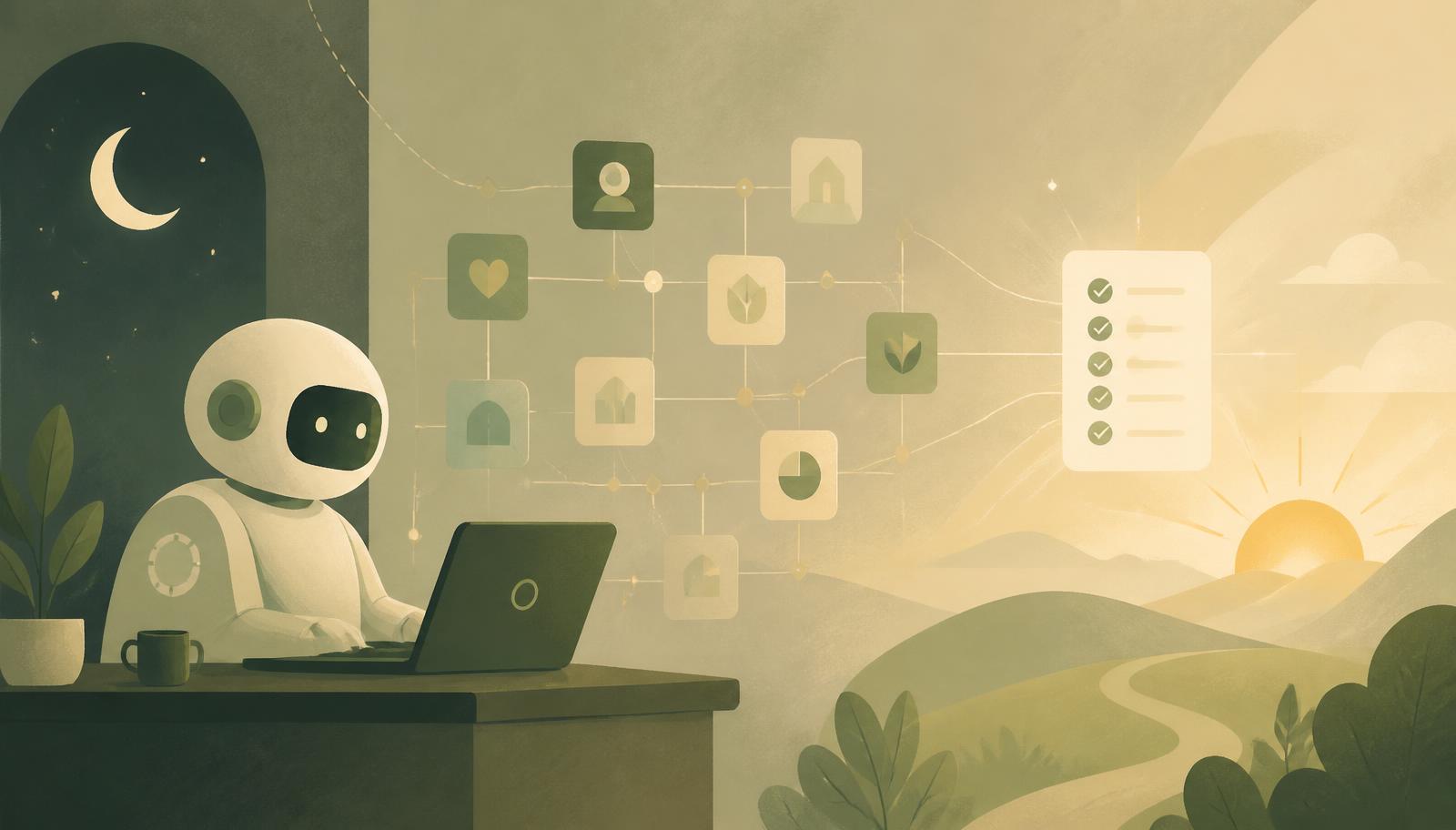
What is an AI agent in major gifts fundraising? An agent is software that works your donor portfolio without being asked: it scans on a schedule, decides what matters, and brings you a ranked list with reasons. A chatbot answers when you ask. An agent notices while you are doing something else, then tells you.
On this page
- The gap between using AI and gaining from it
- What "agentic" actually means
- What an agent does in a major gifts week
- The part most vendors skip
- How to test an agentic claim before you buy
- Where agents should not be trusted yet
- How this works in Gratefully
The gap between using AI and gaining from it
Almost every nonprofit now uses AI. Almost none of them are getting much from it.
The 2026 Nonprofit AI Adoption Report, published by Virtuous and Fundraising.AI in February 2026 and based on 346 organizations surveyed in December 2025, found this:
| Finding | Figure |
|---|---|
| Organizations now using AI | 92% |
| Reporting small to moderate improvements | 79% |
| Reporting major improvements | 7% |
| Using AI on an ad hoc basis, without documented workflows | 81% |
| Describing their use as reactive and individual | 65% |
| Using AI systematically | 4% |
| Holding no AI governance policy | 47% |
Note who published that. Virtuous is a fundraising CRM and a direct competitor of ours. We are citing their research because it is the best data available on this question, and because a competitor reporting an unflattering number about their own market is more credible, not less.
Read the 81% and the 4% together, because that is the whole story. The problem is not that nonprofits lack access to AI. Ninety-two percent have it. The problem is that it lives in individual browser tabs, used reactively, with nothing written down. Nathan Chappell, Virtuous's chief AI officer, calls this being stuck at the "efficiency plateau".
An agent is the specific thing that closes that gap, because an agent is a documented workflow. It runs whether or not somebody remembers to open a tab.
A second survey, run independently, lands in almost the same place. Omatic's 2026 Nonprofit Technology Ecosystem Trends Report, its fourth annual, analyzed more than 800 responses and found that 70% of nonprofits now run five or more core technology platforms, up from 62% the year before, while only 5% work at an organization with a real plan for AI.
Put the two studies side by side. One says 4% use AI systematically across 346 organizations. The other says 5% have a real plan across more than 800. Two separate samples, two separate methodologies, the same answer. Whatever is missing in this sector, it is not access to AI and it is not enthusiasm. It is that almost nobody has decided, in writing, what the machine is supposed to do each week.
The platform number matters too, and it is the quieter problem. An agent that can only see one of your five systems is not working your portfolio, it is working a fifth of it.
What "agentic" actually means
Agentic AI is software that pursues a goal across multiple steps on its own initiative, deciding what to do next based on what it finds, rather than waiting for an instruction each time. The test is simple: if nothing happens unless a human opens it and types, it is not an agent.
The category gets muddled because three different things are all sold as "AI for fundraising".
| Type | What it does | In major gifts | What it cannot do |
|---|---|---|---|
| Predictive | Scores records against historical patterns | Ranks who is likely to give or lapse | Tell you why, or do anything about it |
| Generative | Produces text from a prompt | Drafts the appeal, the thank you, the brief | Know which donor needs it, or when |
| Agentic | Runs a multi-step job on a schedule and decides what matters | Watches the portfolio, surfaces who needs attention, prepares the work | Judge a relationship, or carry it |
Most tools marketed as agentic are generative tools with a scheduler attached. The distinction that matters to a buyer is whether the system decides, or merely runs.
The two meanings, and why the confusion matters
As of mid 2026 the word "agentic" is being used for two genuinely different things in fundraising, and they are often discussed as though they were one.
| Agents working for the fundraiser | Agents working for the donor | |
|---|---|---|
| Sometimes called | Agentic AI, AI teammates | Agentic giving |
| Who it serves | Your development team | The supporter, or their assistant |
| What it does | Watches your portfolio, ranks who needs attention, prepares the work | Discovers causes, checks their legitimacy, completes a gift on the donor's behalf |
| What it changes | How much of your file you can actually work | How gifts arrive, and whether a human ever sees your appeal |
| Buy it to | Increase the capacity of the team you have | Not applicable. This one happens to you |
Be clear about what the second one is today: a category announcement, not a product. Fundraise Up named "Agentic Giving" in July 2026 and stated plainly that it is not announcing products or launch dates, and that it is defining the category and helping nonprofits prepare. Treat anyone selling you agentic giving right now with the skepticism that deserves.
This page is about the first. The second is worth watching rather than buying, because it changes who your fundraising is addressed to. If a donor's assistant is screening causes on their behalf, your case for support has to be legible to software as well as to a person, and the organizations that publish clear, structured, verifiable information about their work will be the ones it finds.
The practical overlap is this: both futures reward the same discipline, which is having your donor knowledge written down and retrievable rather than held in somebody's head.
What an agent does in a major gifts week
Concretely, and in the order it happens.
- It reads the portfolio on a schedule, typically overnight, rather than when someone opens a dashboard. Nobody has to remember anything for this to happen.
- It scores movement, not just status. A donor who has given at the same level for six years is stable. A donor whose third consecutive gift came later than the last one is drifting. The second is the useful signal and it only exists if something is watching over time.
- It assembles context before you need it, so the giving history, past notes, who introduced whom and what was last promised are gathered rather than hunted for.
- It ranks, and it says why. A list without reasoning is just another report. The reasoning is what lets a gift officer disagree with it, which they should be able to do.
- It drafts the next step where the next step is routine: the check in, the thank you, the re-engagement note.
- It stops there. It does not send, and it does not decide the relationship. That boundary is the difference between a useful agent and a liability.
Step two is the one that separates real agents from scheduled reports, and it is worth pressing any vendor on. Detecting that something changed requires memory of what it was before.
The part most vendors skip
An agent is only as good as what it can see, and in fundraising most of what matters was never typed into a database field.
The reason a major donor gives is usually in an email thread, a note from a colleague who has since left, or a conversation somebody remembers and nobody recorded. A CRM holds the transactions. The relationship lives around them.
So an agent working only from structured gift data can tell you that someone's giving slowed. It cannot tell you that their business partner died in March, that they asked about the capital campaign twice, or that the last person to steward them promised a site visit that never happened.
This is why "agentic" and "institutional memory" are the same conversation. An agent without access to the unstructured record is doing pattern matching on payment history. Useful, but it is not what the word implies. We wrote about the memory half of this problem in the institutional memory crisis.
How to test an agentic claim before you buy
Five questions. The answers separate real capability from a scheduler with a marketing budget.
| Ask this | A good answer sounds like | Worry if you hear |
|---|---|---|
| What runs when nobody logs in? | A named job on a stated schedule, with output waiting in the morning | "You can ask it any time" |
| What does it read besides gift records? | Named sources: email, notes, documents, with how they are ingested | Only CRM fields, or a vague "your data" |
| Can it show why it flagged someone? | A citation to the specific record, note or message | A confidence score with no reasoning |
| What does it do without approval? | A short, explicit list, with sending excluded | "It handles outreach for you" |
| What happens when it is wrong? | You can correct it and the correction sticks | No mechanism, or "it learns over time" |
The fourth question is the important one. An agent that sends on your behalf is not a productivity gain, it is an unreviewed communication from your organization to your largest donors.
Where agents should not be trusted yet
Being honest about this is not a caveat, it is the buying advice.
| Do not hand over | Why not | What to do instead |
|---|---|---|
| Judging a relationship | An agent sees that contact stopped. It cannot know the donor is ill, that a board member fell out with them, or that the silence is mutual and deliberate | Let it flag the silence. You decide what it means |
| Deciding an ask amount | Capacity models estimate what someone could give. What they will give in this campaign, after this conversation, is judgment | Use it for the capacity range, not the number on the page |
| Anything irreversible | Sending, pledging, committing a visit. There is no undo on a message to a major donor | Draft and stop. Approval stays human |
| Working from a thin record | With three CRM fields and no notes, an agent confidently surfaces very little | Fix the record first. A tool will expose a data problem, not solve it |
That last row is the honest reason so many nonprofits sit in the 79% seeing small gains rather than the 7% seeing major ones. The tool arrived before the record was worth reading.
How this works in Gratefully
Gratefully is a donor intelligence layer that sits on top of the CRM you already run. It is not a CRM and it is not wealth screening. If wealth screening is what you are actually shopping for, how wealth screening tools compare sets out the options on price and sourcing.
Grace runs the portfolio overnight rather than waiting to be asked. In the morning there is a ranked list of who needs attention, with churn risk scored and the reasoning cited back to the record it came from, so a gift officer can check the logic rather than trust a number. It reads the unstructured material as well as the gift history, which is what makes the movement signals in step two above possible.
The nightly job also surfaces revenue already sitting in the file: the mid-level donor who has given steadily for years and has never been asked for more. That is hidden revenue discovery, and it is the clearest example of an agent finding something a human would need weeks to look for.
What it does not do is send. Drafts wait for you. Given the fourth question in the table above, we would rather be on the correct side of it.
You can see the working version of this at the Action Center.
The same capabilities, described for the officer's daily workflow, are on our donor stewardship page.
> The word agent is doing a lot of work in this market right now, and most of what it is attached to is a scheduled report. The test I would apply is not what the software can do when you are watching. It is what it noticed while you were not. Everything else is a dashboard with better marketing.
>
> — Muddsar Jamil, founder, Gratefully
Frequently asked questions
What is agentic AI in fundraising?
Agentic AI is software that pursues a goal across several steps on its own initiative, deciding what to do next based on what it finds, instead of waiting for a prompt. In fundraising this usually means scanning a donor portfolio on a schedule, identifying who needs attention, and preparing the work before a gift officer asks for it.
What is the difference between predictive AI and agentic AI?
Predictive AI scores records against historical patterns to estimate likelihood, such as who may lapse or give. Agentic AI acts on a schedule and decides what matters, then assembles the context and the next step. Prediction produces a number. An agent produces a prepared piece of work.
Do AI agents actually improve fundraising results?
The evidence so far is mixed. The 2026 Nonprofit AI Adoption Report found 92% of organizations using AI but only 7% reporting major improvements, with 81% using it on an ad hoc basis without documented workflows. The gap suggests the constraint is workflow rather than model quality.
Should an AI agent send emails to donors on my behalf?
We would say no. Preparation is where the time is saved, and an unreviewed message from your organization to a major donor carries risk that no efficiency gain justifies. Look for tools that draft and stop.
What data does an AI agent need to be useful in major gifts?
More than gift records. The reason a major donor gives is usually in email threads, meeting notes and documents rather than CRM fields. An agent restricted to structured transaction data can detect that giving slowed, but not why, which is the part a gift officer needs.
Is agentic AI safe to use with donor data?
It depends on the vendor's architecture, not on the word agentic. The questions that matter are whether donor data is used to train models, whether personal data is redacted before it reaches a language model, and whether answers are cited so they can be checked.
Author
Muddsar Jamil, Founder, Gratefully
Muddsar spent twenty years building software in Silicon Valley, at Adobe, Workday, and SugarCRM, and nearly as long working alongside nonprofits across the Bay Area. He founded Gratefully to give fundraising teams AI they can actually trust with donor data.
Want more insights like this? Browse all articles or get in touch with our team.