Pledge reminder letters for every stage of a pledge
Quick answer
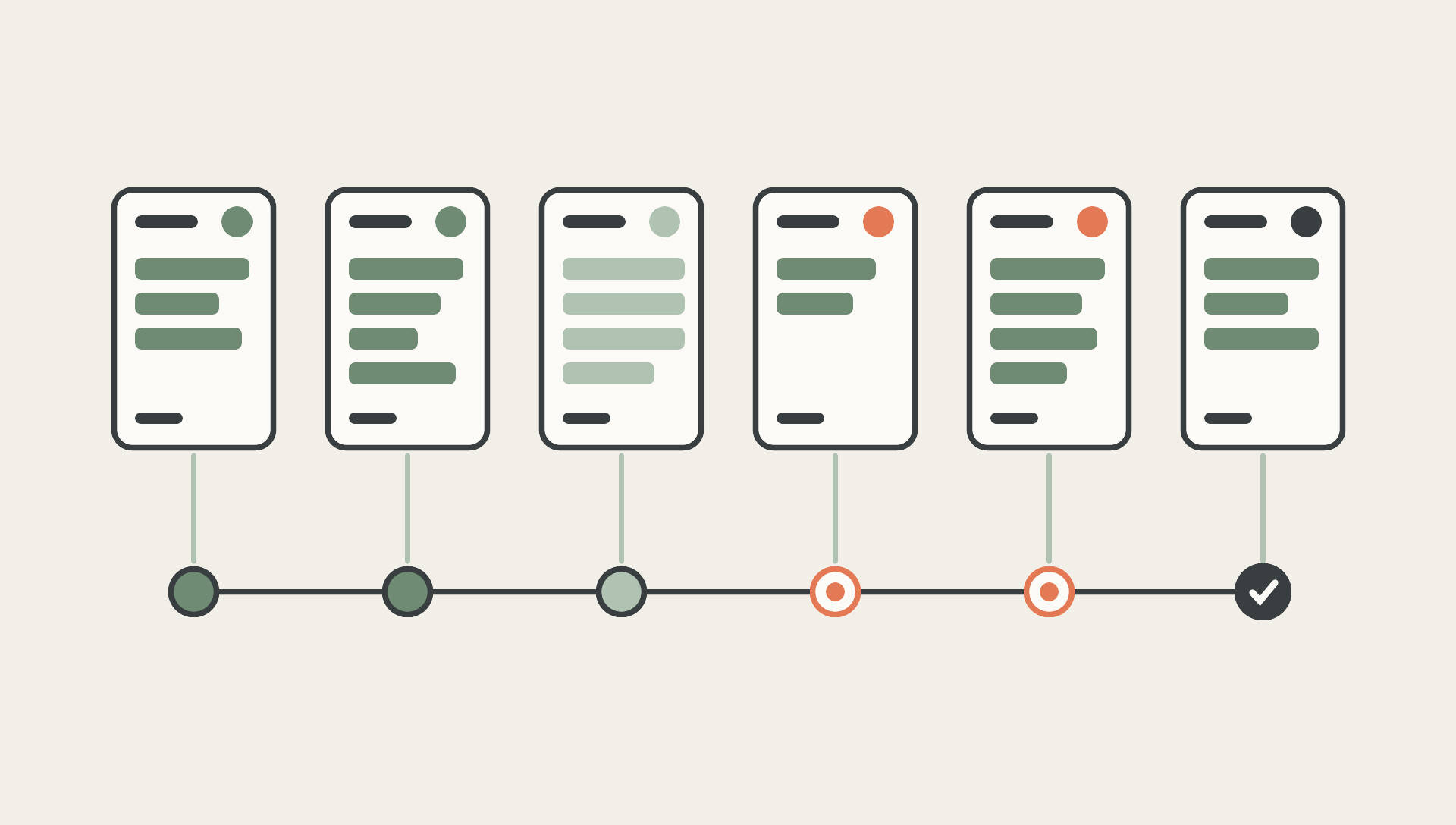
A pledge reminder letter thanks the donor first, then shows what they pledged, what they have paid, what is due next and how to pay. A pledge needs a different note at each stage: when it is made, before each payment, after a missed one and at the end. Below are six letters, one for each stage.
Get all six letters as an editable Word file
Enter your work email and the download starts straight away.
On this page
Why one reminder letter isn’t enough
A pledge reminder letter is a note to a donor who has promised a gift in installments, sent before a payment is due, that thanks them and sets out what they have paid and what comes next. It is not an appeal: the donor already said yes.
Search for a pledge reminder letter and you’ll find one letter, often headed “Friendly reminder”, with the amount and the due date. That letter does one job. A pledge that runs for three years needs several: confirming the promise, thanking the donor before each payment, checking in when a payment doesn’t arrive, offering a way out when life changes, and closing the pledge when it’s paid.
The six letters below follow the pledge from the day it’s made to the day it’s complete. Each one says what the donor needs at that stage and leaves out what they don’t.
The six stages at a glance
| Stage | When to send | What it says | What it never says | Letter |
|---|---|---|---|---|
| Pledge made | Within a week of the pledge | Thank you, and here is the schedule we agreed | That this is a tax receipt | 1 |
| Payment coming up | About 30 days before each payment | What the pledge has done so far, then the balance and how to pay | “Friendly reminder” as the headline | 2 |
| Payment coming up, paid by a finance team | Same timing, when the donor asks for a statement | The numbers, laid out like a statement | Anything that asks a donor-advised fund to “pay the pledge” | 3 |
| Payment recently missed | About two weeks after the due date | A check-in, and an offer to change the schedule | “Overdue” or “missed” | 4 |
| Payment long overdue | About 60 to 90 days after the due date, with no reply to letter 4 | The amount outstanding and three ways forward | Anything that reads like a collection letter | 5 |
| Pledge complete | Within a week of the final payment | Thank you, and what the whole pledge did | A new ask | 6 |
What every reminder should show
A reminder that says “your payment is due” and nothing else sends the donor looking for their own records. Put the whole picture in the letter. These are the fields to pull from your CRM for letters 2, 3 and 5.
| Field | Example | Why it matters |
|---|---|---|
| Total pledged | $15,000 over three years | Reminds the donor of the promise in their own terms |
| Designation | Scholarship fund | Shows the money is going where they asked |
| Paid to date, with dates | $7,500, last payment March 3 | Thanks them for what they have already done |
| This payment and its due date | $2,500 due June 1 | The one number they need to act on |
| Balance after this payment | $5,000 | Shows how close they are to finishing |
| Future payment dates | December 1, June 1 | Lets them plan, especially through a finance team or a fund |
| How to pay | Link, check address, or bank details given by phone | Removes the last reason to put it off |
| Pledge reference | Pledge ID or campaign code | Gets the payment applied to the pledge instead of recorded as a new gift |
The example figures are illustrations only. Check “paid to date” against your gift records before every send. If your CRM doesn’t record payments against the pledge itself, that number may be wrong, and a donor who has paid and is told they haven’t is the hardest one to win back.
The six letters
Each letter has a “use when” line, an email subject line and the letter. Bracketed text is yours to replace. Delete any bracket you can’t fill truthfully, and use only figures from your own records.
1. Confirm the pledge
Use when: a donor has just made a pledge, within a week.
Email subject line: Confirming your pledge to [Organization]
Dear [First name],Thank you for your pledge of $[total pledged] to [designation]. [One sentence on what it will make possible.]
So that we both have the same record, here is the schedule we agreed:
Total pledge: $[total pledged]
Payments: $[installment amount], [monthly / quarterly / once a year], from [first due date] to [last due date]
How to pay: [giving link, check address, or “call me for bank transfer details”]
Before each payment is due, I’ll send you a short note with your balance and a link, so you don’t need to keep track of it. If the schedule stops working for you at any point, tell me and we’ll change it.
This letter confirms your pledge. It isn’t a receipt for tax purposes. We’ll acknowledge each payment as it arrives [or: in a year-end summary that lists each payment].
With thanks,
[Signature]
[Name, title]
What makes it work: it sets up every letter that follows. The donor knows reminders are coming and that they can change the schedule. It also separates the promise from the receipt, because the IRS treats a gift as made when it is paid, not when it is pledged.
2. Before a payment is due
Use when: a payment is due in about 30 days.
Email subject line: What your pledge has done so far, [First name]
Dear [First name],Since you made your pledge in [month, year], your payments have [specific result]. [One sentence: one person or moment your pledge was part of.]
Your next payment of $[amount] is due on [date]. Here is where your pledge stands:
Total pledge: $[total pledged]
Paid so far: $[paid to date], most recently on [date]
This payment: $[amount], due [date]
Remaining after this payment: $[balance after this payment]
You can pay at [giving link] or by check to [address].
Thank you for the commitment you made to [the people or cause you serve]. It lets us plan [what dependable funding lets you do].
[Signature]
[Name, title]
P.S. If you’d rather get these by [email / post] instead, just reply and I’ll switch.
What makes it work: it leads with what the money did, so the numbers read as an update on something the donor is part of. The full picture is there in four lines, so the donor never has to look anything up.
3. Pledge statement
Use when: the donor pays through a company, a family office, a foundation or a donor-advised fund, or asks for something their finance team can process.
Email subject line: Pledge statement for [donor or company name], [designation]
[Organization legal name][Address] | EIN [number]
Pledge statement as of [date]
Donor: [donor or company name]
Pledge date: [date]
Designation: [designation]
Pledge reference: [pledge ID]
Total pledged: $[total pledged]
Received to date: $[paid to date]
[Date]: $[amount]
[Date]: $[amount]
Due [date]: $[amount]
Balance after this payment: $[balance]
Future payments: $[amount] on [date]; $[amount] on [date]
How to pay: [check payable to, and address] | [giving link] | Bank transfer: please call [name] on [phone] for details
Please quote the pledge reference with your payment so it is applied to this pledge.
Questions: [name, email, phone]
This statement shows a payment schedule. It is not a tax receipt. [Organization] acknowledges each payment when it is received.
What makes it work: some payers need a document their finance team can file, and gift-services teams get asked for exactly this. Keep a short personal note from the relationship holder alongside it. Give bank details by phone or through a secure portal rather than in an emailed document. For a donor-advised fund, send the statement to the donor, not to the fund, and see Pledge payments and the IRS before you word anything.
4. A payment was recently missed
Use when: a payment is about two weeks late, and it’s the first one the donor has missed.
Email subject line: Checking in, [First name]
Dear [First name],I wanted to check in, and to thank you again for your support of [designation]. [One sentence of news about the work your pledge funds.]
If anything has changed for you since you made your pledge, I’d like to hear about it. We can move your payment dates, spread the balance over a longer time, or pause for a while, whichever helps.
And if it simply slipped through, that’s no trouble at all. You can make your next payment of $[amount] at [giving link].
[Signature]
[Name, title]
What makes it work: it never says “overdue” or “missed”. It offers help before it mentions the payment, and mentions it only once. If you know the donor well, call instead and send this only if you can’t reach them.
5. A payment is long overdue
Use when: a payment is 60 to 90 days late, or two payments have been missed, and letter 4 got no reply.
Email subject line: Your pledge to [designation]: can we adjust it?
Dear [First name],When you pledged $[total pledged] to [designation] in [month, year], it helped us [what the pledge let you commit to]. So far you have given $[paid to date], and I’m grateful for every part of it.
Our records show $[amount outstanding], due on [date or dates], hasn’t arrived yet. I’m not writing to press you. A plan that fits your life now is better for both of us than one that doesn’t.
Could you let me know which of these works best?
- Keep the pledge as it is, and pay the $[amount outstanding] at [giving link].
- Spread the remaining $[balance] over [a longer period].
- Close the pledge at the $[paid to date] you have already given, with our thanks.
You can reply to this [letter / email] or call me on [phone].
[Signature]
[Name, title]
What makes it work: it states the amount once, plainly, and gives three ways forward, so the donor can say a smaller yes instead of saying nothing. Option 3 lets them leave with dignity. Before you offer it, agree with your finance team how a reduced or closed pledge is recorded, since it changes what your books show as still owed. After this letter, follow up once a quarter at most, or close the pledge. If a donor stops replying altogether, our lapsed donor letters start from why a donor stopped.
6. The pledge is complete
Use when: the final payment has arrived, within a week.
Email subject line: Your pledge is complete, [First name]
Dear [First name],Your final payment arrived on [date], and with it your pledge of $[total pledged] to [designation] is complete. Thank you.
Over [number of months or years], your pledge [specific overall result].
[One or two sentences: what that work looks like now, and one thing that comes next.]
When you have a moment, I’d like to tell you about [next phase or next year’s plans]. Would you be open to a short call in [month]? There’s nothing to decide now.
With gratitude,
[Signature]
[Name, title]
P.S. Your [year] giving summary, listing each payment and its date, will arrive in [month].
What makes it work: it closes the pledge cleanly and makes the thank-you the whole point. The next conversation is invited, not asked for, so the letter never reads as “thanks, now give again”.
When to send each one
Omatic’s guide to pledge reminders says 30 days’ notice before a payment is typically enough, with some organizations sending a softer note at 60 or 90 days. For donors still behind after reminders at 30, 60 and 90 days, it suggests following up quarterly. The schedule below builds on that.
- Day 0 to 7: send letter 1 as soon as the pledge is made.
- About 30 days before each payment: send letter 2, or letter 3 to donors who pay through a finance team. Email may need less lead time than post.
- About two weeks after a missed payment: send letter 4, or call.
- About 60 to 90 days after a missed payment, with no reply: send letter 5.
- After that: follow up once a quarter at most, or close the pledge.
- Within a week of the final payment: send letter 6.
The two-week and 60 to 90 day points for a missed payment are our suggestion, not a benchmark. Move them to suit how well you know the donor.
Pledge payments and the IRS
Three IRS points change what your pledge letters should say. This is general information, not tax advice.
A pledge is not deductible when it is made. IRS Publication 526 tells donors: “You can deduct your contributions only in the year you actually make them in cash or other property.” A pledge made in November and paid in March counts in the year of the March payment. That is why letter 1 says it isn’t a receipt. A donor who wants a payment to count this year needs to make it by December 31. A check mailed to a charity counts as delivered on the date it is mailed.
Each payment counts on its own. Publication 526 says that in deciding whether a contribution is $250 or more, donors shouldn’t combine separate contributions: “Each payment is a separate contribution.” So:
- An installment of $250 or more needs a written acknowledgment. Donors can use a separate acknowledgment for each payment, or one that lists each contribution, its date, and the total. Letter 6’s P.S. describes the second kind.
- An installment under $250 doesn’t need one on its own, even if the pledge adds up to far more. The donor still needs a bank record or a written record from you for every cash gift, whatever the amount.
The IRS’s six required elements of an acknowledgment are set out in our thank-you letter guide.
Paying a pledge from a donor-advised fund is not settled. In Notice 2017-73, the IRS said it was considering rules under which a grant from a donor-advised fund would not be treated as giving the donor more than an incidental benefit just because the donor had pledged to the same charity, as long as the fund’s sponsor “makes no reference to the existence of any individual’s pledge” when making the grant. That notice described rules the IRS was considering. It did not finalize them. If a donor wants to pay a pledge this way, ask them to check with their fund’s sponsor first, and don’t word your statement as a request for the fund to pay the pledge.
If you also need a pledge agreement
A pledge agreement is the signed document that sets out the gift, the schedule and any conditions, and it is often used for larger, multi-year gifts. Your reminders should match it exactly: the same total, the same dates, the same designation. If they don’t, fix the record before you send the next letter.
Whether a pledge is legally binding, and how a written agreement should be worded, depends on your state’s law. Have a lawyer draft your agreement or review a template before you use it.
Where Gratefully fits
The letters are the easy part. The hard part is knowing, every week, whose payment is coming up, whose is late, and whose pledge is nearly done.
In Gratefully, the Pledges tab shows what donors still owe, what is overdue, what is due in the next 30 days and what share of pledges are on schedule. Pledges come in on their own from Salesforce, Bloomerang, Little Green Light or HubSpot, or from a spreadsheet if you don’t use a CRM. Grace, the AI development associate inside Gratefully, drafts a note that fits where each pledge stands, covering three of the stages in this guide: a thank-you before an installment, a warm check-in when a payment is recently late, and an invitation to renew when a pledge is nearly paid off. You read and change every draft before anything goes out. Gratefully never takes payments, and where your CRM doesn’t record payments against a pledge, the Pledges tab marks the amount paid as an estimate. See how Pledges works.
Sources
- Internal Revenue Service, Publication 526 (2025), “Charitable Contributions,” sections “When To Deduct,” “Cash Contributions” and “Amount of contribution”: https://www.irs.gov/publications/p526 (read 27 November 2026)
- Internal Revenue Service, “Charitable contributions: Written acknowledgments”: https://www.irs.gov/charities-non-profits/charitable-organizations/charitable-contributions-written-acknowledgments (read 27 November 2026)
- Internal Revenue Service, Notice 2017-73, Internal Revenue Bulletin 2017-51: https://www.irs.gov/irb/2017-51_IRB (read 27 November 2026)
- Omatic, “Pledge Reminder Letters: A Complete Guide for Nonprofits,” 30 April 2025: https://omaticsoftware.com/blog/pledge-reminder-letters-guide/ (read 27 November 2026)
Last updated November 27, 2026.
Frequently asked questions
How do you write a pledge reminder letter?
Thank the donor first and say what their pledge has done so far. Then set out the total pledged, the amount paid to date, the next payment and its due date, the balance after it, and how to pay. Send it about 30 days before the payment is due.
How often should you send pledge reminders?
Once before each payment, about 30 days ahead, plus a confirmation when the pledge is made and a thank-you when it is complete. If a payment is missed, check in after about two weeks, follow up at 60 to 90 days, and after that no more than once a quarter.
Is a pledge tax deductible when it is made?
No. IRS Publication 526 says a contribution is deductible only in the year it is actually paid. Each payment on a pledge counts in the year it is made, and each payment is a separate contribution for the $250 acknowledgment rule.
Can a donor pay a pledge from a donor-advised fund?
It isn’t settled. In Notice 2017-73 the IRS described rules it was considering that would allow it if the fund’s sponsor makes no reference to the pledge, but it did not finalize them. Ask the donor to check with their fund’s sponsor first.
Should a pledge reminder look like an invoice?
Usually not. Most donors should get a letter that thanks them first. Companies, foundations and donors who pay through a finance team often prefer a statement they can process, so keep a statement version (letter 3) for them, and still send it with a personal note.
Author
Muddsar Jamil, Founder, Gratefully
Muddsar Jamil is the founder of Gratefully, an AI donor intelligence platform for nonprofit development teams. He spent twenty years building software at Adobe, Workday and SugarCRM, and volunteered with Bay Area nonprofits throughout. He writes about donor retention, stewardship, and what happens to institutional knowledge when a development director leaves.
Want more insights like this? Browse all articles or get in touch with our team.