Donation request letter templates for every donor you’ll ask
Quick answer
A donation request letter asks one person for a specific gift for a specific purpose. Below are nine templates, with versions for people who have never given and versions built from a donor’s own giving history. All nine are in one editable Word file, and the compliance section covers what to add before you mail.
Get all nine letters as an editable Word file
Enter your work email and the download starts straight away.
On this page
What a donation request letter has to do
A donation request letter is a written ask, sent to a named person, for a gift of a stated size toward a stated purpose. It is different from an acknowledgment, which confirms a gift already made, and from a receipt, which carries the details a donor needs for their taxes. Those two are covered in our donor thank-you letter guide.
The leading template guides give much the same advice, and it’s sound: use the person’s name, tell one story, ask for a specific amount, say what that amount does, and make giving easy. Where most of their templates fall short is that they’re written as if the reader has never given. When the reader is a past donor, a letter that ignores their history reads like it went to everyone.
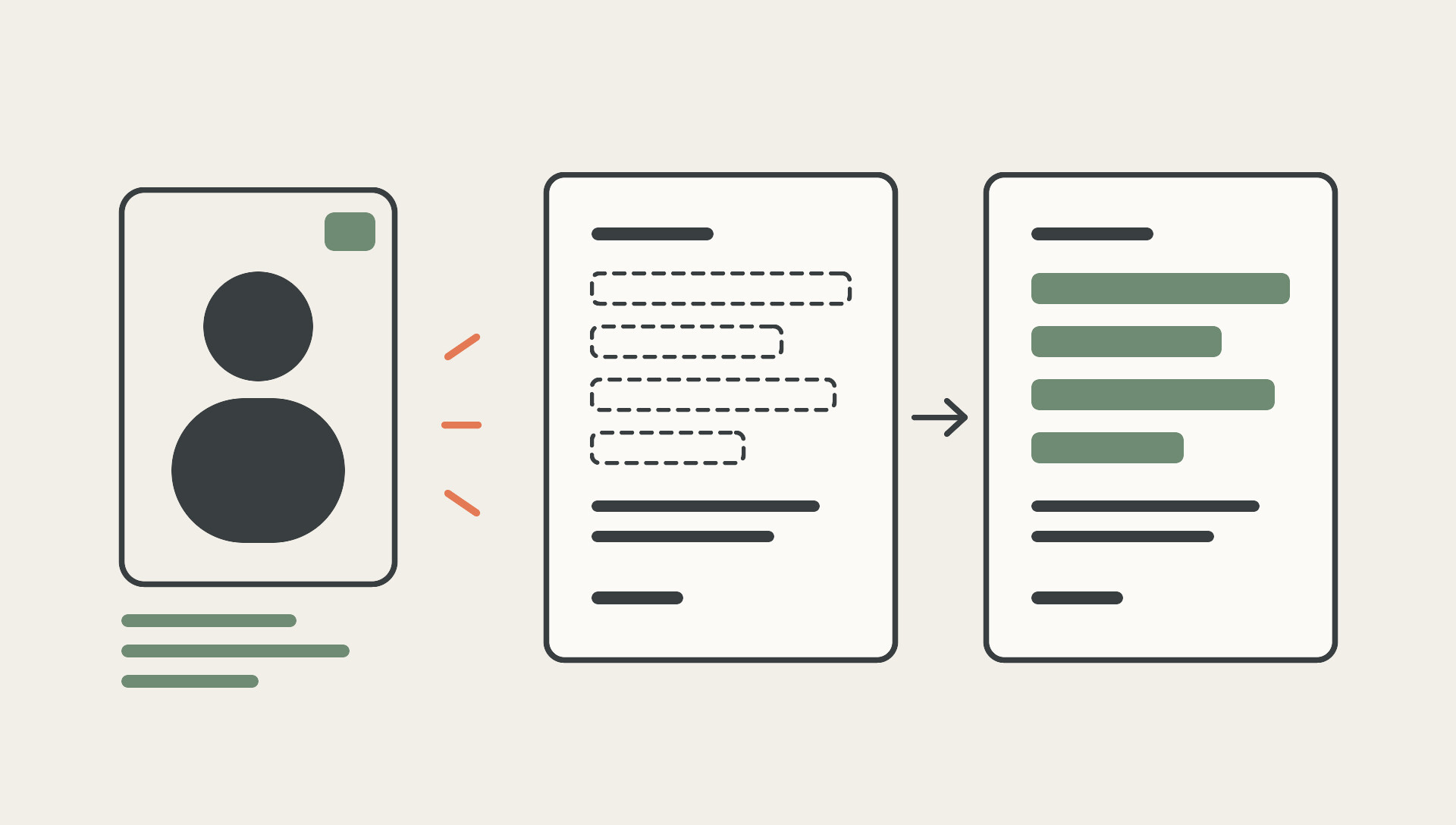
So every template below that applies to existing donors comes in two parts: the letter, and the lines that change when you know the donor’s record.
Three facts to pull from the donor’s record first
Before you write a single ask to a past donor, pull three things from your CRM. Each one turns into a sentence in the letter.
| Fact | Where it usually lives | The sentence it becomes |
|---|---|---|
| Last gift: amount and date | Gift history on the donor record | “Your gift of $[amount] in [month year] did [what it did].” |
| What that gift funded | Fund, campaign or designation on the gift | “You chose to support [program]. Here’s what happened there since.” |
| How long they’ve given | First gift date, or count of years with a gift | “You’ve stood with us since [year].” |
If you can’t find one of these, leave that line out rather than guess. A wrong amount or the wrong program tells the donor the opposite of what you meant.
From Muddsar: The three facts above are the difference between a letter and a mail merge. They’re also the part that takes the time. If you only have time for one, use the program they funded. It’s the detail that shows you know why they gave, not just that they did.
How much to ask for
A request letter should name an amount. “Any amount helps” is true, but a named amount gives the reader something specific to say yes to. Set the number from what you know about the person:
- Someone who has never given. Use an amount tied to a concrete outcome in your own program costs (“$[amount] covers [one unit of what you do]”), and offer two or three options.
- A past donor, same appeal. Ask for their last gift again, and name it, so the letter shows you know their history.
- A donor you want to step up. Anchor on their last or largest gift and ask for one clear step above it, with the reason the extra amount matters now.
- A lapsed donor. Ask for no more than they last gave. The goal is the return, not the size.
- A monthly giving ask. Translate the annual figure into a monthly one the donor can picture: “$[monthly amount] a month, which over a year comes to $[annual amount].”
Use the numbers your own program costs support. Every amount in the templates below is a bracketed placeholder for that reason.
The nine templates
Each template has a “use when” line, an email subject line, and the letter. Bracketed text is yours to replace. Delete any bracket you can’t fill truthfully. Writing a December appeal? Our year-end appeal letters are split by donor list, from lapsed donors to monthly givers.
1. First ask: someone who has never given
Use when: the person knows of you, through an event, a referral or a volunteer, but has never made a gift.
Email subject line: [First name], can I ask for your help with [program]?
Dear [First name],[How they know you, in one sentence: “Thank you for coming to [event] last month.” / “[Referrer] suggested I write to you.”]
[Organization] [does what, for whom, where, in one sentence]. This [season / month], [the specific need, in one or two sentences, with one real person or moment if you have permission to share it].
I’m writing to ask you to join us with a gift of $[amount]. That amount [concrete outcome]. If a different amount suits you better, $[smaller amount] or $[larger amount] would also [outcome for each].
You can give at [short link] or by returning the enclosed card in the envelope provided. [Deadline if there is a real one: “We need to reach $[goal] by [date] to [reason].”]
Thank you for considering it.
[Signature]
[Name, title, direct email or phone]
P.S. [One sentence that restates the ask and the outcome.]
2. Past donor, same appeal
Use when: the donor gave to this appeal, or this program, before.
Email subject line: [First name], here’s what your last gift did
Dear [First name],In [month year] you gave $[last gift amount] to [program]. [One or two sentences on what happened in that program since, ideally something their gift was part of.]
[The need this year, in one or two sentences.]
Would you renew your support with a gift of $[last gift amount] this [season]? It would [concrete outcome].
You can give at [short link], or reply to this letter and I’ll take care of the rest.
With thanks for [number] years of standing with us,
[Signature]
[Name, title, direct email or phone]
What changes with the donor’s record: the first paragraph is the whole letter. Without the amount, date and program it becomes template 1 with a warmer opening.
3. Upgrade ask
Use when: a donor has given at the same level for some time and you have a reason to ask for more now.
Email subject line: [First name], a bigger moment for [program]
Dear [First name],Thank you for your gift of $[last gift amount] in [month year], and for [number] years of support before that. [One sentence on what their giving has made possible.]
This year [what is different: a new site, a waiting list, a match, a deadline]. Because of that, I’m asking a small number of our most loyal supporters to consider a larger gift.
Would you consider $[step-up amount] this year? It would [the specific outcome the larger amount makes possible that the usual amount would not].
If that isn’t right for you this year, your usual gift of $[last gift amount] will still [outcome], and we are grateful for it.
[Short link] | [Phone]
[Signature]
4. Lapsed donor
Use when: the donor gave in the past but not in your last giving cycle.
Email subject line: [First name], we’ve missed you at [Organization]
Dear [First name],It’s been a while since your gift of $[last gift amount] in [month year] to [program], and I wanted to write to you myself.
[One or two sentences on what’s changed in that program since they last heard from you.]
If you’d like to be part of it again, a gift of $[last gift amount or less] would [outcome]. You can give at [short link].
And if something about how we’ve been in touch hasn’t worked for you, I’d genuinely like to know. Just reply to this letter.
[Signature]
5. Monthly giving conversion
Use when: a donor has given single gifts more than once and you run a monthly program.
Email subject line: [First name], would you give monthly?
Dear [First name],You’ve given to [Organization] [number] times since [year]. Thank you.
I’m writing to ask whether you’d consider making your support monthly. [One sentence on why steady income matters to the program: planning, staffing, a waiting list.]
$[monthly amount] a month comes to $[annual amount] over a year, [comparison to their usual gift if true: “close to what you already give”], and it means we can [outcome] without waiting for the next appeal.
You can set it up at [short link], and change or stop it whenever you like.
[Signature]
6. Business or corporate request
Use when: asking a local business or a company’s community giving program for a cash gift.
Email subject line: Request for support: [program] in [community]
Dear [Name],[How you know the business, or why you’re writing to them: “[Business] has served [community] since [year].” / “Your community giving program lists [cause] as a focus.”]
[Organization] [does what, for whom, in their community]. We’re asking local businesses to help us [specific goal] by [date].
A gift of $[amount] would [concrete outcome]. In return, we’d [the recognition you actually offer: listing in [publication], logo on [materials], a mention at [event]], if that’s useful to you.
[If the company has an application process, follow it and use this letter as the cover note.]
I’d be glad to talk it through. I’m at [phone] or [email].
[Signature]
[Organization] is a 501(c)(3) organization, EIN [number].
7. In-kind or auction item request
Use when: asking a business or individual for goods or services rather than money.
Email subject line: Could [Business] donate [item] for [event or program]?
Dear [Name],[Organization] is [holding event / running program] on [date] to [purpose].
We’re looking for [specific item or service, with quantity: “two gift cards for dinner”, “printing for 500 flyers”, “a weekend stay”]. Your donation would [how it will be used: auctioned to raise funds for [program] / used directly by [people served]].
We’d [recognition you actually offer] and send you a written acknowledgment of the donation for your records.
If you’re able to help, I can collect the item by [date], or you can drop it at [address].
Thank you for considering it.
[Signature]
8. Event ask, with the disclosure built in
Use when: inviting someone to buy a ticket, a table or a package where they receive something in return.
Email subject line: [First name], join us at [event] on [date]
Dear [First name],I’d love you to join us at [event] on [date] at [venue]. [One sentence on what the evening is for.]
Tickets are $[price]. [Optional: “Tables of [number] are $[price].”] Every ticket helps us [outcome].
Of each $[price] ticket, $[fair market value of dinner and entertainment] is the estimated value of goods and services you receive. The amount you can deduct for federal income tax purposes is limited to the difference, $[price minus value].
Reserve at [short link] by [date].
[Signature]
The bold paragraph is there because of the IRS quid pro quo rule, explained in the compliance section. The figure must be a good-faith estimate of the fair market value of what the donor receives.
9. Matching gift prompt
Use when: the donor works for, or recently gave through, a company with a matching gift program.
Email subject line: [First name], your gift could be matched by [Company]
Dear [First name],Thank you for your gift of $[amount] on [date].
[Company] [matches employee gifts / has matched gifts to us before], which means your gift could do [twice / the multiple] the good at no extra cost to you. It usually takes [a few minutes] through [the company’s matching portal / your HR team].
[Link to the company’s matching form, if you have it]
If you’ve already submitted it, thank you, and please ignore this note.
[Signature]
If you’re working matches across a whole donor file, our Company Matches capability finds the gifts an employer would match and tracks each one until the company pays.
From Muddsar: Notice that templates 2 to 5 open with something the donor did, not something you need. That’s deliberate. A past donor already said yes once. The letter’s first job is to show you remember.
If they don’t answer: the follow-up
No reply to a first letter isn’t the same as a no. Plan two follow-ups before you send the first letter.
- Second message, about [10 to 14] days later, by email. Shorter than the letter. Refer to it, restate the ask in one sentence and give the link.
Subject: Following up on my letter, [First name]
Dear [First name], I wrote last week about [program]. If you’d like to help, a gift of $[amount] would [outcome]. Here’s the link: [short link]. Thank you either way. [Signature]
- Third message, near the real deadline. Only send it if there is a real deadline or a real update.
Subject: [Number] days left for [goal]
Dear [First name], we’re [amount or percentage] from [goal], and the deadline is [date]. If you’ve been meaning to give, now is the moment: [short link]. [Signature]
- Then stop, and note it on the record. Mark the donor as not responding to this appeal so the next letter they get is not another ask for the same thing.
The bracketed timings are a starting point. Use your own response data if you have it.
What to add, and what to leave out
In November 2026 we read six of the leading donation request letter guides, from Kindsight, GoFundMe Pro, Givebutter, Bonterra, Donorbox and Donately. None of the six pages mentions disclosure statements or the quid pro quo rule, and three of them suggest adding tax-exempt or tax-benefit language without saying when it has to be qualified. Here is what applies to a request letter, with the source for each.
| Situation | What the letter needs | Source |
|---|---|---|
| The donor will receive something in return and pays more than $75 (a ticket, a dinner, a gift) | A statement that the deductible amount is limited to what they pay above the value of what they receive, and a good-faith estimate of that value. It can go in the request itself. | IRS, “Charitable contributions: Quid pro quo contributions” |
| You solicit in Florida and are required to register there, or are exempt under section 496.406(1)(d) | On every solicitation, confirmation, receipt or reminder, displayed conspicuously, this statement with the Division’s toll-free number and website: “A COPY OF THE OFFICIAL REGISTRATION AND FINANCIAL INFORMATION MAY BE OBTAINED FROM THE DIVISION OF CONSUMER SERVICES BY CALLING TOLL-FREE WITHIN THE STATE. REGISTRATION DOES NOT IMPLY ENDORSEMENT, APPROVAL, OR RECOMMENDATION BY THE STATE.” | Florida Statutes, section 496.411(3) |
| You solicit in Maryland | A statement on all written solicitations and receipts that your current financial statement is available on request, with your name, address and phone number, and that documents filed under the Maryland Solicitations Act are available from the Secretary of State. | Maryland Secretary of State, Business Regulation sections 6-411 and 6-101(g) |
| You solicit in other states | Check the state’s charity registration office. Harbor Compliance, a compliance services firm, says twenty-five states require disclosure statements on solicitation materials. | Harbor Compliance, Charitable Disclosures |
Maryland’s own sample wording, from the Secretary of State: “A copy of the current financial statement of [name of charity] is available by writing [address where requests should be directed] or by calling (XXX) XXX-XXXX. Documents and information submitted under the Maryland Solicitations Act are also available, for the cost of postage and copies, from the Maryland Secretary of State, State House, Annapolis MD 21401, (410) 974-5534.”
What to leave out:
- “Your gift is fully tax-deductible” on anything the donor gets something back for. Under the IRS rule above, only the amount above the value of what they receive is deductible, and the IRS allows the required disclosure to go in the solicitation itself.
- Specific tax advice. Say what is true about you, such as your 501(c)(3) status and EIN, and leave the donor’s tax position to the donor and their adviser.
- Statistics you can’t source. A number in a request letter is a claim. If you can’t say where it came from, use a story instead.
This is general information, not legal advice. Disclosure rules change, and your registration status in each state decides which apply to you.
Where Gratefully fits
The templates above are the easy part. The hard part is templates 2 to 5 for a few hundred donors, each with the right last gift, date and program, and none of it guessed.
That’s what Gratefully’s Outreach Letters are for. Grace, the AI development associate inside Gratefully, drafts appeals, re-engagement letters and year-end asks grounded in each donor’s real history, in your organization’s own voice. Select a segment and she writes an individually personalized letter for each donor, which you can download as a CSV for a mail merge. Gratefully never sends anything without a person approving it. If you’d rather find the donors who need a letter first, start with the ones at risk of lapsing.
Sources
- Internal Revenue Service, “Charitable contributions: Quid pro quo contributions”: https://www.irs.gov/charities-non-profits/charitable-organizations/charitable-contributions-quid-pro-quo-contributions (read 20 November 2026)
- Florida Statutes (2026), section 496.411, “Disclosure requirements and duties of charitable organizations and sponsors”: http://www.leg.state.fl.us/statutes/index.cfm?App_mode=Display_Statute&URL=0400-0499/0496/Sections/0496.411.html (read 20 November 2026)
- Maryland Secretary of State, “Disclosure Requirements and Financial Statement Requirements”: https://sos.maryland.gov/Charity/Pages/Disclosure-Requirements.aspx (read 20 November 2026)
- Harbor Compliance, “Charitable Disclosures”: https://www.harborcompliance.com/charitable-solicitation-disclosures (read 20 November 2026)
- Guides reviewed for the comparison in the compliance section, read 20 November 2026: Kindsight, “A comprehensive guide to the donation request letter”; GoFundMe Pro, “6 Donation Request Letter Best Practices + Templates”; Givebutter, “How to write a donation request letter”; Bonterra, “15 donation request letter templates and how to write your own”; Donorbox, “Fundraising Letters: Asking for Donations Made Easy”; Donately, “Donation Request Letter Templates, and the Giving Path They Should Point To”
Last updated November 20, 2026.
Frequently asked questions
What should a donation request letter include?
The donor’s name, one story or concrete need, a specific amount with what it will do, how to give, a deadline if there is a real one, and your signature with direct contact details. For past donors, add their last gift, its date and the program it supported.
How long should a donation request letter be?
Long enough to carry one story and one clear ask. Most of the templates above fit on one page. Let the story set the length, not a word count.
Should a donation request letter say the gift is tax-deductible?
You can state your 501(c)(3) status and EIN. If the donor receives goods or services in return and pays more than $75, the IRS requires a written statement that the deductible amount is limited to what they pay above the value received, with a good-faith estimate of that value. It can go in the solicitation or the receipt.
How do I ask a business for a donation?
Use template 6 for cash or template 7 for goods and services. Say why you’re writing to that business, ask for something specific, and offer only the recognition you actually provide. If the company has an application process, follow it.
When should I follow up on a donation request letter?
A short email about 10 to 14 days after the letter is a reasonable starting point, plus a final note shortly before the deadline if there is a real one. Then stop and record that the donor didn’t respond to this appeal.
Author
Muddsar Jamil, Founder, Gratefully
Muddsar Jamil is the founder of Gratefully, an AI donor intelligence platform for nonprofit development teams. He spent twenty years building software at Adobe, Workday and SugarCRM, and volunteered with Bay Area nonprofits throughout. He writes about donor retention, stewardship, and what happens to institutional knowledge when a development director leaves.
Want more insights like this? Browse all articles or get in touch with our team.