Knowledge Graphs for Institutional Memory: Why Nonprofits Lose Donors When Staff Leave
When a development officer leaves your organization - whether they retire after twenty years, move to another city, or give two weeks' notice on a Tuesday - they don't just take their talent with them. They take something far more operationally dangerous: the web of relationships, context, and unwritten history that lives only in their head.
This is the institutional memory crisis in fundraising. Most nonprofits don't realize how much relationship intelligence has evaporated until they try to answer a simple question like "why did Margaret stop giving in 2022?" and discover that the person who knew the answer is unreachable. The data in your CRM is technically still there. The *context* is gone.
This post explains why knowledge graphs are the only data architecture built specifically to solve this problem - and why every other tool your team has tried (shared drives, wikis, better CRM training, documentation mandates) eventually fails at the same structural limit.
TL;DR
- Institutional memory is relationship context, not data. Your CRM stores transactions. It doesn't store the "why" behind them - and it especially doesn't store the reasoning behind what *didn't* happen.
- Knowledge graphs connect entities across time and source. A graph stores "Margaret Chen" as a single canonical node linked to every mention of her across emails, notes, documents, and gift history - with provenance on each connection.
- This is different from a CRM. A CRM stores structured records. A knowledge graph resolves identity across unstructured and semi-structured sources, and preserves the reasoning behind decisions even after the decider has left.
- Every other workaround fails. Wikis go stale. Handover meetings are incomplete. Documentation is never kept current. Only a system that captures context *at the source* and makes it queryable survives staff turnover.
The Anatomy of Institutional Memory Loss
To understand why knowledge graphs matter, start with what actually disappears when someone leaves.
The Three Layers of Lost Knowledge
Layer 1 - Transactional data (the 40% that stays): This is what lives in your CRM. Gift history, contact details, event attendance, proposal status. It's structured, reportable, and survives turnover because it was entered into a system designed for persistence.
Layer 2 - Relational context (the 35% that usually disappears): This is the invisible layer. Margaret used to be a board member at the symphony - that's why she cares about arts education. She prefers being contacted by email, not phone, because of a hearing issue her late husband had. She stopped attending the gala after the 2019 venue change because it conflicted with her granddaughter's birthday. None of this is in your CRM. It was in one person's notes, memory, and judgment.
Layer 3 - Decision reasoning (the 25% that is almost never captured): Why did the team decide not to solicit Margaret for the capital campaign in 2023? Because her husband had just been diagnosed. Who made that call? The former director of development. Where is the record of that reasoning? In a Slack DM, a hallway conversation, or nowhere at all.
When a development officer leaves, Layer 1 stays. Layers 2 and 3 evaporate. Over time, your organization is left with a database full of *what* happened and almost no record of *why* - which means the next person can't make informed decisions about what to do next.
Why Every Workaround Eventually Fails
Most nonprofits have tried to solve this. The attempts are well-intentioned and structurally doomed.
Wikis and Documentation
The documentation approach asks staff to write down what they know. The problem is that context changes faster than documentation. A wiki page about "Margaret Chen" written in January is misleading by June - and no one has the job of keeping it current. Documentation is a snapshot. Relationships are a movie.
Handover Meetings and Exit Interviews
These are valuable but incomplete. A departing officer can relay what they remember in the moment. What they can't do is surface everything - the years of micro-decisions, the informal cues, the evolved understanding of a donor's temperament that only exists as pattern recognition in their own mind.
"Better CRM Discipline"
This is the most common trap. A nonprofit concludes that if everyone just entered better notes into Salesforce, the problem would go away. But CRM notes fields weren't designed for narrative reasoning. They're flat text boxes with no linking, no provenance, and no way to query across them at scale. "Better discipline" usually means more incomplete data entered into the wrong tool.
Shared Drives and Folders
Moving documents into a shared location solves the access problem (everyone can reach the files) but not the retrieval problem. A folder of PDFs about Margaret is useless to a new officer who doesn't know which files exist, which are current, and how they connect to what's in the CRM.
The common failure mode across all these approaches: they rely on a human to *remember to document, organize, and update* institutional knowledge. Humans don't do this reliably. The only architecture that works is one that captures context automatically, at the source, and makes it queryable without requiring anyone to remember where they stored it.
What a Knowledge Graph Actually Does
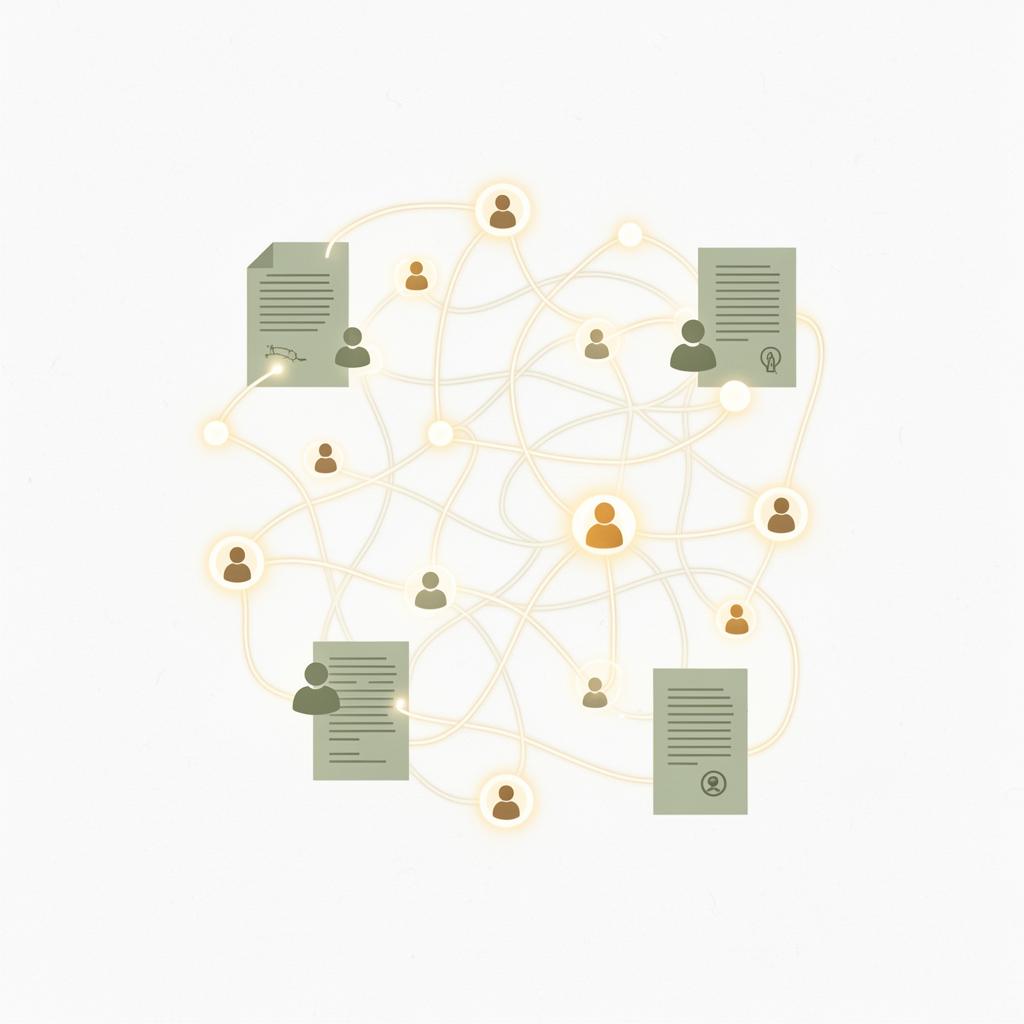
A knowledge graph is a database that stores entities (people, organizations, events, documents) as nodes, and relationships between them as edges. What makes it different from a relational database (like a CRM) is how it handles identity, provenance, and inference.
Entity Resolution: One Margaret, Everywhere
In a typical nonprofit data environment, "Margaret Chen" appears in multiple systems with slight variations:
- In the CRM as "Margaret Chen"
- In a board member's email as "M. Chen"
- In a former officer's handwritten notes as "Maggie"
- In an event RSVP list as "Dr. M. Chen"
- In a Slack thread as "the Chens"
A knowledge graph uses entity resolution to collapse these references into a single canonical node. Every assertion about Margaret - her giving history, her email thread about the 2022 gala, the note about her husband's diagnosis, the mention in a board packet - links to that same node. The graph doesn't just store data. It stores *connections*.
Provenance: Every Answer Has a Source
When you ask a knowledge graph "why did Margaret's giving drop in 2023?" the answer comes with citations. "Gift frequency decreased 60% following a diagnosis mentioned in an email from March 2023 (source: email thread, former development director)." This isn't generated from a language model's training data. It's retrieved from the actual documents in your organization's corpus - with a pointer back to the original source.
This matters enormously for institutional memory. A new development officer doesn't have to trust an AI's summary. They can read the original email, the original note, the original meeting minutes. The graph preserves not just the conclusion but the path to it.
Queryability in Plain English
The third property is what makes a knowledge graph usable by non-technical staff. Once the graph is built, you can ask it questions in natural language. "Which donors in my portfolio used to give quarterly but haven't given in the last 18 months?" The graph traverses the entity network - gift frequency, donor identity, time ranges - and returns a list with reasoning. No SQL. No report building. No remembering which dashboard has the answer.
Why This Is Different From a CRM
It's worth being precise about the architecture, because many nonprofits assume their CRM already does this. It doesn't.
CRMs store structured records. A gift record has a donor ID, an amount, a date, a campaign attribution. These are rows in a table. The structure is fixed by the database schema. If you want to capture something the schema wasn't built for - say, the emotional tenor of a donor meeting - you force it into a notes field where it loses all structure and linkability.
Knowledge graphs store relationships. A donor node connects to a gift node, an email node, a document node, an event node. The connections have types ("attended," "sent," "mentioned in," "decided against soliciting because of"). The graph grows organically as new sources are added. There's no schema limit on what kind of context can be captured.
CRMs answer "what." What did Margaret give? When? To which campaign?
Knowledge graphs answer "what, why, and what next." What did Margaret give, why did her pattern change, and who else in my portfolio has a similar risk profile?
The Gratefully Implementation
Gratefully is a knowledge-graph intelligence layer built specifically for nonprofit donor data. Here's how the architecture maps to the institutional memory problem.
Ingestion From Every Source
Gratefully reads from your CRM (Salesforce for Nonprofits, Bloomerang, Little Green Light), your email platform for engagement signals (Mailchimp, Constant Contact, HubSpot), and the documents and spreadsheets you upload. Nothing is migrated. Nothing is duplicated as the source of truth. The graph is a *layer on top* of the systems you already have.
Entity Resolution Across Sources
When Gratefully ingests data, it resolves entities across sources using a combination of deterministic matching (same email, same name + address) and probabilistic inference ("M. Chen" in a document and "Margaret Chen" in the CRM are likely the same person based on contextual overlap). For the full architecture, see entity resolution across nonprofit sources. The result is a single donor profile that aggregates every mention across every system - with a source citation on every assertion.
Natural Language Interface (Grace)
Once the graph is populated, Gratefully provides a conversational interface. You can ask:
- "Who in my portfolio hasn't been personally contacted in 90 days?"
- "What do we know about the Chen family's giving history beyond what's in the CRM?"
- "Which donors were mentioned in the 2023 board retreat notes but haven't been solicited since?"
Every answer cites the source documents. Every answer is drawn from your organization's actual data, not from a language model's training corpus.
Proactive Intelligence
The newest layer - Proactive Intelligence - means Grace doesn't just answer questions. She surfaces what you should be asking. Overnight scans of the graph identify churn risk, unstewarded revenue, and portfolio gaps. By morning, the institutional memory isn't just preserved - it's actively working.
What Changes in Practice
The best way to understand the impact is to compare two scenarios.
Without a Knowledge Graph
Your development director of eight years departs. Their replacement inherits:
- 800 donor records in Salesforce
- 200 "contact reports" in a shared folder, mostly undated and unlinked to donor records
- A 30-minute handover meeting where the departing director remembered maybe 40 key relationships
- A few sticky notes on a monitor
Three months later, a major donor lapses. The new director doesn't know why. They search the CRM - the donor gave consistently for six years, then stopped. They search the shared folder - nothing with this donor's name. They ask around - the one person who knew the donor's family had a health crisis in 2023 is gone. The relationship is unrecoverable.
With a Knowledge Graph
The same departure. The replacement inherits:
- 800 donor records in Salesforce (unchanged - still the system of record)
- A knowledge graph with resolved entities, source citations, and queryable context
- The ability to ask Grace: "what do we know about why donor 784 stopped giving?"
- An answer, with citations: "Gift frequency dropped after March 2023. Email thread indicates family health concern. No solicitation was sent per explicit request. Source: email, development director, 2023-03-14."
The replacement doesn't need eight years of accumulated intuition. They need the ability to ask the right question - and a system that preserved the answer.
Conclusion
Institutional memory loss is not a training problem, a discipline problem, or a documentation problem. It is a structural problem. The tools most nonprofits use to store knowledge weren't designed to preserve the kind of contextual, relational, narrative information that actually drives donor relationships.
Knowledge graphs were built for exactly this. They resolve identity across fragmented sources. They preserve provenance on every assertion. They make institutional memory queryable in plain English - by the person who recorded it, and by the person who replaces them.
If your organization has ever lost a donor because "the person who knew that relationship left," the solution isn't better note-taking. It's a different architecture entirely.
*Want to see how a knowledge graph would map your own donor data? Schedule a conversation with our team.*
Want more insights like this? Browse all articles or get in touch with our team.