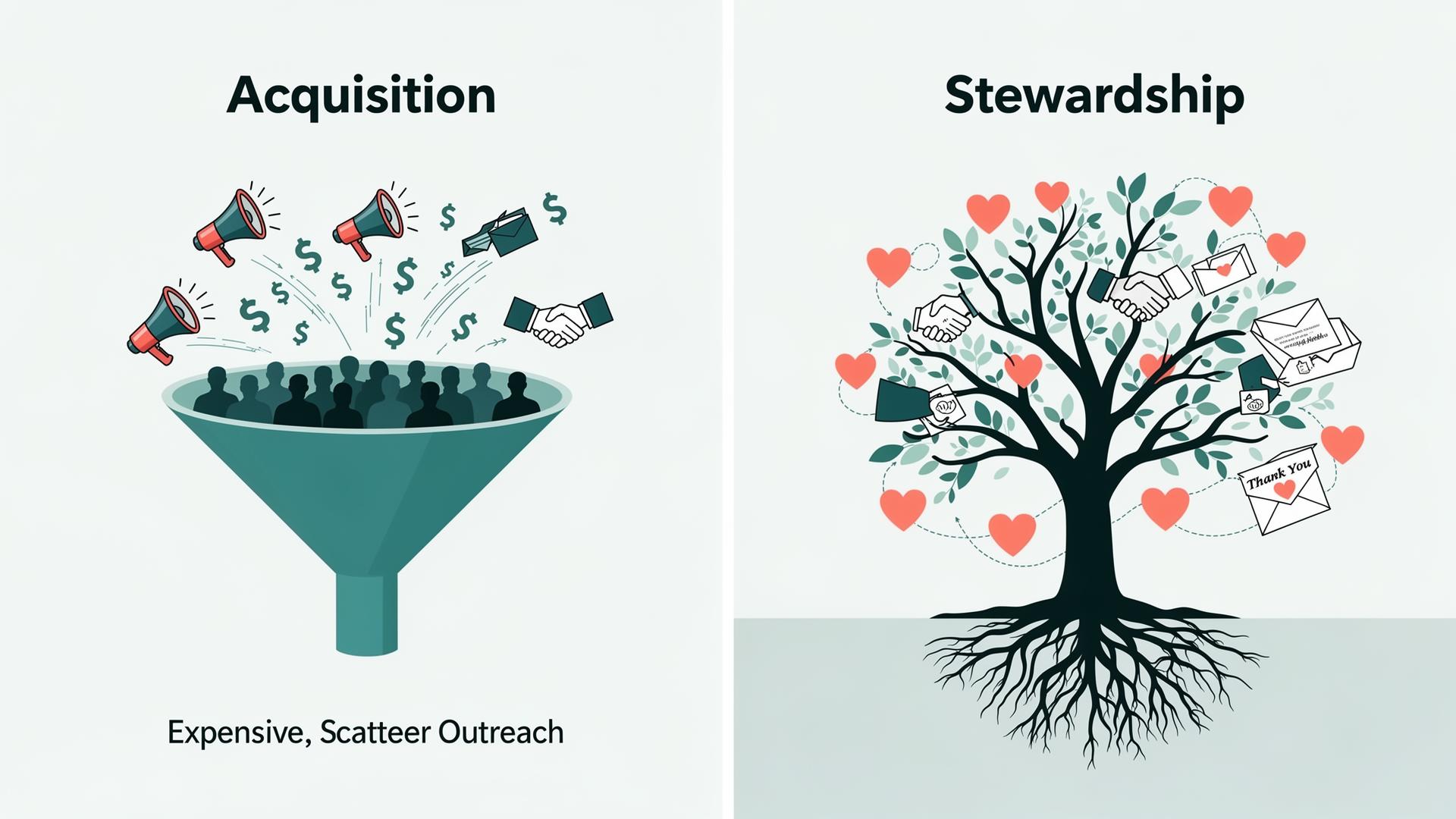
Donor Stewardship: A Complete Guide for Nonprofit Teams
Donor stewardship is everything you do for a donor after the gift arrives, and before you ask again. Most guides argue it prevents donors from leaving. The survey data does not really support that. What stewardship reliably does is make the donors who stay give more, and that is a better reason to invest in it.
In this guide:
- What donor stewardship actually is
- Why donors really stop giving
- What stewardship is actually worth
- The stewardship matrix: cadence by donor tier
- How to build a donor stewardship plan in 7 steps
- How to measure stewardship
- Making stewardship survive staff turnover
- How Gratefully helps
- Frequently asked questions
What donor stewardship actually is
Donor stewardship is the set of things you do after a gift is received: acknowledging it, reporting on what it achieved, recognising the donor appropriately, and keeping the relationship warm between asks.
It is worth separating three terms that get used interchangeably, because they describe different moments in the relationship.
| Term | When it happens | What it is for |
|---|---|---|
| Cultivation | Before the gift | Building interest and readiness to give |
| Solicitation | The ask itself | Requesting a specific gift |
| Stewardship | After the gift | Demonstrating impact, sustaining the relationship, earning the next gift |
The distinction matters operationally. Cultivation and solicitation are usually somebody's job. Stewardship is usually nobody's job, which is why it is the piece that quietly disappears when a team gets busy.
Why donors really stop giving
Here is where most stewardship advice goes wrong. The standard claim is that donors leave because they were not thanked properly. It is a comfortable argument, because it makes the fix cheap and puts it entirely within your control.
The best recent survey data does not support it. When Presbyterian Church (U.S.A.) Research Services surveyed 1,275 donors who had paused or stopped giving, published April 2026, the reasons broke down like this:
| Reason for pausing or stopping | Selected by |
|---|---|
| Chose to give through their local congregation instead | ~40% |
| Other written-in reasons, mostly cause preference or limited finances | ~40% |
| Uncertain about restructuring, or no longer felt connected | ~8% |
| Disagreed with organisational decisions | ~7% |
| Could no longer afford to give | ~7% |
| Unsure how their money was used | ~4% |
| Did not feel adequately recognised or thanked | under 1% |
Respondents were asked to select every reason that applied, so the column totals above 100%. That detail makes the last row more striking rather than less. Nobody had to choose between "I could not afford it" and "I was not thanked." They could tick both. Fewer than one in a hundred ticked the second.
One caveat we will state plainly, because most articles would not: this is a single denominational study, not a cross-sector sample, and its findings will not transfer perfectly to a food bank or an arts organisation. Treat it as a strong signal rather than a universal law.
But the signal is worth taking seriously. Donors mostly leave for reasons that live outside your acknowledgement process: money, competing loyalties, and drift. Only about 4% pointed at not understanding where their money went, which is the one line on that list stewardship directly owns.
So why bother with stewardship at all? Because preventing defection was never the strongest argument for it.
What stewardship is actually worth
The most useful research on this is Penelope Burk's, published in Donor-Centered Fundraising. A sample of new donors received a thank-you phone call from a board member within 48 hours of their gift arriving. The rest did not.
Donors who received the call gave 39% more than donors who did not, the next time they were asked.
Sit with the shape of that finding. The call did not stop anyone leaving. It changed the size of the next gift from people who were going to give anyway. That is stewardship working as a multiplier, not as insurance.
Two honest notes on this figure, since we would rather you hear them from us. It comes from a book rather than a peer-reviewed journal, and the full methodology is not openly published. It is also not a recent study. We use it because it is the most specific, most attributable finding in this area, and because it has never been credibly contradicted, but treat it as directional.
The modern equivalent, and the number you can actually benchmark against, is second-gift conversion. The 2026 Virtuous Nonprofit Benchmark Report (771 mid-sized US nonprofits) found:
| Second gift measure | Average | Top quartile |
|---|---|---|
| First-to-second gift conversion | 25.84% | 37.86% |
| Median days between first and second gift | 108.5 | 68 |
The gap between those columns is stewardship. Same acquisition spend, same donors, roughly half again the conversion rate and a window forty days shorter.
For the cost side of this argument, how much more expensive acquiring a donor is than keeping one, see our separate breakdown of what donor acquisition really costs.
The stewardship matrix: cadence by donor tier
Most stewardship plans fail because they are written as one plan for everybody, which means they are written for nobody. A matrix fixes that. Yours will differ, but this is a defensible starting structure.
| Donor tier | Acknowledge within | Ongoing cadence | Owned by |
|---|---|---|---|
| Major | 24 hours, phone call | Quarterly personal contact, annual in-person or video impact update, named recognition where wanted | Executive Director or lead gift officer |
| Mid-level | 48 hours, personalised letter or call | 3 to 4 impact touches a year, at least one with no ask attached | Development Director |
| Recurring or sustainer | 48 hours, welcome sequence | Impact update at 3 months, anniversary acknowledgement, card expiry watch | Development staff, automated where possible |
| First-time | 48 hours, specific acknowledgement | Second-gift sequence inside 90 days, well ahead of the 108 day sector median | Development staff |
| Everyone else | 72 hours, receipt plus real thank-you | 2 impact updates a year, one survey or feedback ask | Automated, reviewed quarterly |
The recurring and first-time rows are where most value leaks. If you want the signals that tell you a donor is drifting before they lapse, we cover them in how to know which donors are at risk of lapsing, and the recovery playbook for the ones you have already lost is in how to re-engage lapsed donors.
Two rules make the matrix work. Every tier gets a real thank-you, not just a tax receipt, because an automated receipt is a transaction record and donors read it as one. And at least one touch per year per tier carries no ask, which is the single most common gap we see.
How to build a donor stewardship plan in 7 steps
- Segment your file into tiers. Use the matrix above as a starting point. If you want a more rigorous method than gift size alone, our guide to RFM analysis covers recency, frequency and value segmentation in plain English. If you cannot pull these segments from your systems in under an hour, that is a data problem to solve before it is a stewardship problem.
- Write down what each tier receives. Acknowledgement method, timing, and the number of non-ask touches per year. One page, not a strategy document.
- Assign an owner to every row. Stewardship fails when it belongs to everyone. Name a person per tier, including board members for major donors, since that is what Burk's finding rests on.
- Build the acknowledgement templates once. Specificity is what works: "your $50 funded five hot meals in our spring programme" outperforms "thank you for your generous gift." Templates get you specificity at speed.
- Instrument the second gift. Measure first-to-second conversion and median days between gift one and two. Sector average is 25.84% and 108.5 days. If your second-gift sequence starts later than 90 days, it starts too late.
- Schedule the non-ask touches first. Put impact updates in the calendar before appeals. Appeals always find their way into a calendar. Impact updates do not.
- Review quarterly against the numbers. Not "did we send the newsletter" but "did conversion move." The measurement section below covers what to watch.
For the pipeline discipline that sits underneath a stewardship plan, including the published stage benchmarks, see our guide to moves management.
How to measure stewardship
Stewardship is usually measured by activity, which tells you nothing. Measure outcomes instead.
| Metric | What it tells you | 2026 benchmark |
|---|---|---|
| First-to-second gift conversion | Whether your post-gift experience works at all | 25.84% average, 37.86% top quartile |
| Days between first and second gift | Whether your sequence is fast enough | 108.5 median, 68 top quartile |
| Repeat donor retention | Whether stewardship holds people once they are in | 59.3% |
| Overall donor retention | The headline number your board will ask for | 43.3% |
| Recurring donor retention at 12 months | Your best-performing cohort, if you have one | 71% |
| Percentage of donors receiving a non-ask touch | The leading indicator for all of the above | Set your own, most organisations cannot answer it |
Retention figures are from the Fundraising Effectiveness Project full-year 2025 data. For the strategy layer that sits on top of these numbers, see our donor retention strategies playbook. Recurring retention is from M+R Benchmarks 2026, which blocks automated checks, so that one figure was confirmed through two secondary reports of the study rather than the source page directly.
That last row is the one worth adding to your dashboard, because it is the only leading indicator on the list. Everything above it tells you what already happened.
Making stewardship survive staff turnover
There is a failure mode nobody puts in stewardship guides, and it is the one that does the most damage.
Good stewardship runs on context. Which programme this donor funds, that they lost a spouse last year, that they always give in November, that they hate phone calls. In most organisations that context lives in one person's head, their inbox, and a scattering of notes nobody else opens.
Then that person leaves. In the Social Impact Staff Retention survey, fielded in autumn 2024, 67% of people in fundraising roles said they were looking for a new job or expected to be within a year. The stewardship plan survives the departure. The knowledge that made it work does not.
We have written about the wider version of this problem in the institutional memory crisis, which looks at what happens to donor retention when a development director leaves. Three things make stewardship durable rather than personal:
- Write context into the donor record, not the inbox. If it only exists in an email thread, it is already lost.
- Log why, not just what. "Called, left message" is worthless in eighteen months. "Called about the literacy programme, which she funds because her mother taught adult reading classes" is not.
- Make the plan a document, not a habit. A habit leaves with the person who had it.
How Gratefully helps
Everything above is doable by hand for a hundred donors. It stops being doable somewhere in the low thousands, which is where most teams quietly abandon the plan they wrote. Gratefully's donor stewardship tools are built for that gap:
- Smart Donor Segments classify every donor nightly (New, Loyal, At-Risk, Lapsed and more) from the recency, frequency and value of their giving, so your stewardship tiers stay current instead of being a quarterly export that is out of date by February.
- The Action Center works your whole portfolio overnight and puts the stewardship that is actually at stake at the top of your morning: the unthanked first gift, the mid-level donor drifting, the recurring gift that just failed. Priorities carry forward until you act on them.
- The workflow launcher turns a segment into finished work. Filter to first-time donors from the last 90 days and generate individually personalised acknowledgements grounded in each donor's actual gift, which is the specificity that makes Burk's finding work.
- Context that outlives staff. Interactions logged in conversation are written back to the donor record, so the reasoning behind a relationship stays with the organisation.
Gratefully connects to the CRM you already run, Salesforce for Nonprofits and Bloomerang natively, Little Green Light, or any system via CSV. There is a free plan at $0, and published pricing from $79 a month billed annually, with the five-seat team plan at $399 a month billed annually and a 14-day trial of the top plan.
Last updated July 31, 2026.
Frequently asked questions
What is donor stewardship?
Donor stewardship is everything you do after a gift arrives and before you ask again: acknowledging the gift, reporting on its impact, recognising the donor appropriately, and maintaining the relationship between appeals. It is distinct from cultivation, which happens before the gift, and solicitation, which is the ask itself.
What is the difference between donor cultivation and stewardship?
Cultivation happens before a gift and builds a donor's interest and readiness to give. Stewardship happens after the gift and is about demonstrating impact and sustaining the relationship. In practice they form a loop, because good stewardship is what cultivates the next gift.
Do donors really stop giving because they were not thanked?
Less often than the sector assumes. In a 2026 survey of 1,275 donors who had paused giving, conducted by Presbyterian Church (U.S.A.) Research Services, under 1% cited not feeling adequately recognised or thanked. Financial reasons, competing loyalties and cause preference dominated. The stronger argument for stewardship is not that it prevents departures but that it increases what retained donors give.
How quickly should you thank a donor?
Within 24 to 48 hours for major and mid-level gifts, and within 72 hours for everyone else. The research most often cited here is Penelope Burk's, where new donors who received a board member's thank-you call within 48 hours subsequently gave 39% more than those who did not. Specificity matters at least as much as speed.
What is a donor stewardship matrix?
A donor stewardship matrix sets out what each tier of donor receives and who is responsible for delivering it: acknowledgement method and timing, ongoing contact cadence, and the number of touches per year that carry no ask. It exists so that stewardship is a defined process rather than whatever the team has time for that week.
What should a donor stewardship plan include?
Donor tiers, the acknowledgement each tier receives and how quickly, the annual cadence of contact including non-ask touches, a named owner for each tier, pre-built templates, and the metrics you will review quarterly. One page is usually enough.
How do you measure donor stewardship?
Measure outcomes rather than activity. The most useful metrics are first-to-second gift conversion (25.84% sector average, 37.86% top quartile), median days between first and second gift (108.5 and 68 respectively), repeat donor retention (59.3%), and the percentage of donors who received at least one contact with no ask attached.
How many times should you thank a donor before asking again?
There is no researched ratio, despite the frequently quoted claim that organisations ask far more often than they thank. A practical standard that does hold up: every donor tier should receive at least one meaningful contact per year that carries no ask, and first-time donors should receive a specific acknowledgement before any second solicitation.
Who should own donor stewardship?
Ownership should be assigned per donor tier rather than to one person. Major donor stewardship usually sits with the Executive Director or lead gift officer, mid-level with the Development Director, and everything below that with development staff supported by automation. Board members matter here too, since the strongest research on thank-you calls involves a board member making the call. Stewardship fails most often when it belongs to everybody, which means nobody.
Author
Muddsar Jamil, Founder, Gratefully
Muddsar Jamil is the founder of Gratefully and a 20-year Silicon Valley engineer (Adobe, Workday, SugarCRM) who spent nearly as long volunteering with Bay Area nonprofits. He built Gratefully so donor relationships survive spreadsheets, staff turnover, and guesswork. Connect on LinkedIn.
Want more insights like this? Browse all articles or get in touch with our team.